
Insight Scan Chiropractic: How CLA Insight Scans Reveal Your Nervous System Health
Your child can’t sit still, or you can’t sleep through the night, and every appointment ends the same way: “everything looks normal.” You know something isn’t. Insight scan chiropractic care starts from a different question, one built to measure what a normal exam can’t see: how your nervous system is actually functioning, right now, today.
What Is an INSIGHT Scan, Really?
Most people have never heard the term until a friend mentions it or they find this page searching for answers. An INSIGHT scan is a set of three non-invasive tests that measure how your nervous system is functioning. It replaces guesswork with an actual reading.
The CLA INSIGHT scan combines three technologies into one short office visit: heart rate variability, thermal scanning, and surface electromyography (sEMG). Each one looks at a different signal your nervous system is sending. Together, they build a picture of where stress is living in your body, and how well your system is adapting to it.
This isn’t a diagnostic test in the sense of finding a disease. It’s a functional snapshot. It shows us how your nervous system is regulating your body’s systems today, and it gives us a baseline to track as care progresses.

HRV: A Nervous System Scan Built on Heart Rhythm
Heart rate variability, or HRV, is the space between your heartbeats. It sounds small, but it tells a big story about your autonomic nervous system, the part of you that runs breathing, digestion, and your stress response without you thinking about it.
- What it measures: the balance between your sympathetic (“fight or flight”) and parasympathetic (“rest and digest”) nervous systems, based on the natural variation in time between heartbeats. Low variability often points to a nervous system stuck in overdrive.
- Why it matters here: many of the families we see, especially kiddos with sensory struggles or moms running on empty, are living in a sympathetic-dominant state without realizing it. HRV gives us a number, not a guess.
- What a healthy pattern looks like: more variability generally reflects a nervous system that can shift smoothly between stress and recovery. Every person’s baseline is different, so we look at your pattern over time.
Thermal Scanning: Reading Skin Temperature Along the Spine
The thermal scan measures tiny temperature differences on either side of your spine. Your skin temperature is partly controlled by your autonomic nervous system, so uneven patterns can point to areas where nerve communication is under stress.
- What it measures: paired temperature readings along the spine, comparing the left and right sides at each level. Consistent asymmetry can suggest the nervous system isn’t communicating evenly at that segment.
- Why it matters here: this is radiation-free and quick, which makes it practical for kids and expecting moms alike. It’s one more objective data point layered on top of HRV and sEMG.
- What we’re looking for: patterns, not a single reading. One scan is a data point. A pattern that repeats and improves over time is what tells the real story.

sEMG: Measuring Muscle Tension Patterns Around the Spine
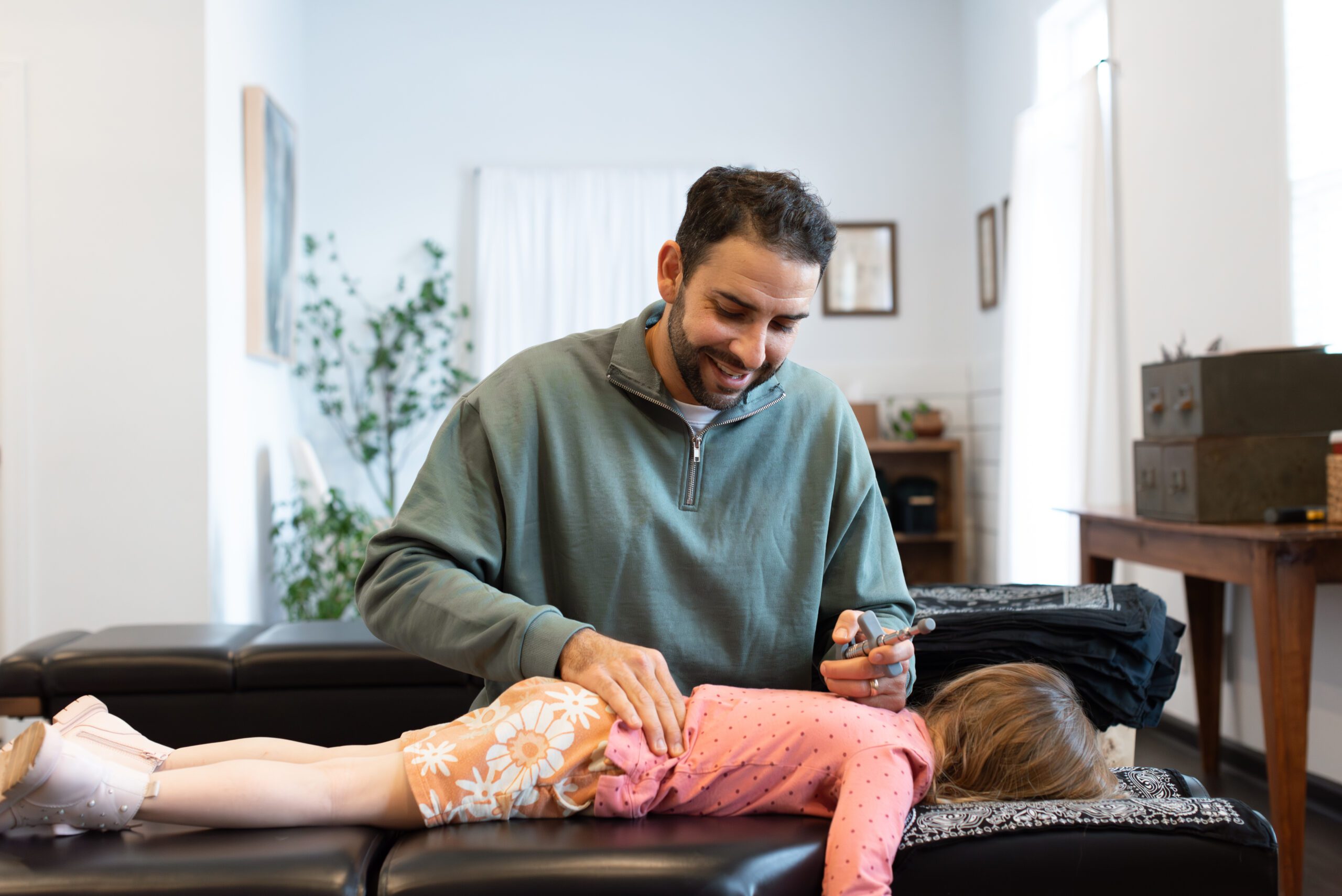
Surface electromyography, or sEMG, uses sensors placed along the spine to measure the electrical activity in the muscles that support it. Chronic nervous system stress often shows up as uneven muscle tension long before someone feels pain.
- What it measures: the amount and symmetry of electrical activity in the paraspinal muscles, compared left to right and level to level. Uneven readings can reflect areas where the nervous system is working harder than it should.
- Why it matters here: this is often where we see the clearest connection to posture, tension headaches, and that “wound up but exhausted” feeling many parents describe in themselves and their kids.
- How we use it: as a baseline at your first visit, then again at set intervals, so you can see whether care is helping your nervous system settle, not just whether symptoms feel different that day.
Why Neurological Testing in Franklin, TN Looks Different Here
Franklin has plenty of chiropractic options, but neurological testing that actually measures your nervous system instead of just checking range of motion is uncommon. This is where insight scan chiropractic care changes the conversation from “does this feel better” to “what does the data show.”
Families across Williamson County drive here from Brentwood, Spring Hill, and Cool Springs specifically for this piece. When a parent has already heard “he’ll grow out of it” from three different providers, a number they can see and track means something. It’s not a promise. It’s a starting point.
The Difference Between a Symptom Check and a Function Check
A standard exam asks whether something hurts or moves correctly. A functional nervous system scan asks a different question entirely: how is your body regulating stress, right now, at this moment in time.
- Symptom-based care: waits for pain or dysfunction to show up, then reacts to it after the fact. It’s useful, but it’s already behind the problem by the time you feel it.
- Function-based care: looks for stress patterns in the nervous system before they show up as full-blown symptoms. That’s the whole idea behind root-cause, insight scan chiropractic care.
- Why this matters for kids especially: a child’s nervous system is still developing, and sensory or behavioral struggles often trace back to how that system is regulating, not to something a standard pediatric exam is built to catch.

Benefits of INSIGHT Scanning for Your Family
Here’s what I’ve seen in practice, over and over, once a family gets their first scan results back. The value isn’t just the reading itself. It’s what that reading lets us do next.
- An objective starting point. Instead of relying only on how you feel that day, you get a baseline reading of your nervous system’s function that we can measure again down the road. Care stops being a guess and starts being tracked.
- A radiation-free, non-invasive process. All three components, HRV, thermal, and sEMG, are painless and fit easily into a single office visit. That matters for kiddos and for expecting moms who want gentle, cautious care.
- A way to track real progress. Many patients notice changes in sleep, focus, or how they handle daily stress within the first few weeks, and repeat scans give us a way to see whether the nervous system pattern is shifting alongside those changes.
- Care built around your actual nervous system, not a generic protocol. Your scan results shape your specific care plan. Two kids with the same ADHD label can have very different nervous system patterns, which is exactly why a one-size-fits-all answer so often misses.
- A tool for honest conversations. When you can see the pattern on a printout, it’s easier to understand what we’re addressing and why, instead of taking it on faith. That transparency is the whole point.
What to Expect During Your INSIGHT Scan Visit
Walking in for your first scan shouldn’t feel intimidating. Here’s what actually happens, in plain terms, so you know what you’re signing up for before you sit down.
- A short conversation first. We talk through what brought you in, whether that’s your own fatigue, your child’s sleep struggles, or a pregnancy you want to support well. This context shapes how we read your results.
- The three scans, back to back. You’ll sit for the HRV reading, then the thermal scan along your spine, then the sEMG sensors placed briefly at several levels. None of it involves needles, radiation, or anything invasive.
- A plain-language review. We walk through your results together, not in jargon, but in terms of what your nervous system pattern is showing and what it may mean for the symptoms you came in with.
- A care plan built around your data. Your scan becomes part of the plan, not a separate report that sits in a file. We reference it again at set intervals to track how your nervous system is responding.


Who Insight Scan Chiropractic Care Is For
This isn’t a niche tool for one type of patient. In our experience, the families who benefit most tend to fall into a few groups, though every nervous system is different, so care plans vary.
- Parents whose kids are struggling and haven’t gotten answers. ADHD labels, sensory sensitivities, trouble winding down at night, or a gut that’s always off. An HRV nervous system scan gives you something concrete instead of another “he’ll grow out of it.”
- Women who keep hearing their labs are normal. Fatigue, brain fog, and hormone symptoms that don’t show up on standard panels can still show up as autonomic stress on a CLA INSIGHT scan. It’s one more piece of the whole picture.
- Expecting and postpartum moms who want gentle, informed care. A baseline nervous system reading during pregnancy is calm, quick, and non-invasive, and it gives us a way to track how your body is adapting through each trimester.
- Performance-minded adults dealing with chronic tension. As someone who played professional soccer before this work, I’ve seen how an overworked nervous system shows up in the body long before an injury does. The scan often confirms what an athlete already feels.
How Insight Scan Results Guide Your Care Plan
Your first scan is a baseline, not a verdict. What matters more is what happens next: how those numbers change as your body responds to consistent, neurologically focused care.
We’re not just chasing symptoms. We’re using your INSIGHT scan data to see whether your nervous system is shifting out of that stuck, overdriven pattern and into one that regulates more smoothly. Re-scans at set intervals let you see that shift for yourself, in numbers, not just in how you feel that particular week.
This is also where honesty matters most. Chiropractic care supports the nervous system. It isn’t a replacement for medical care, and we’ll always tell you when something is outside our scope. Your INSIGHT scan is one part of a bigger picture of your health, and we treat it that way.
How INSIGHT Scanning Fits Into the Bigger Picture
A nervous system scan rarely tells the whole story by itself, and we don’t pretend it does. It’s one piece of a bigger picture that includes your history, your symptoms, and how your body responds to care over time.
For families already working with us on functional medicine, an INSIGHT scan adds another layer to that picture. Gut health, hormones, and inflammation all have a relationship with the nervous system, and a stressed autonomic pattern can show up alongside digestive issues, fatigue, or hormone symptoms that don’t resolve with standard treatment alone.
This is where the whole-person approach matters. Your nervous system doesn’t operate separately from the rest of your body, and treating it as an isolated system misses the connections that actually explain why symptoms show up together. When we see a stressed HRV pattern alongside gut complaints or hormone symptoms, that combination tells us more than either piece would alone.


Why We Track Patterns, Not Single Readings
One scan is a snapshot. A series of scans over weeks or months is a pattern, and patterns are what actually guide decisions about your care.
- A single scan sets the baseline. It tells us where your nervous system stands today, which matters, but it’s only the starting point for a longer conversation about your health.
- Repeat scans show direction. Is the nervous system settling into a more balanced pattern, or is it holding steady, or moving the other way. That trend shapes how we adjust your care plan at your next visit.
- Context always matters. A single stressful week, a poor night of sleep, or an illness can shift a reading temporarily. We look at your pattern across visits, not any one data point in isolation.
For Franklin-area families managing more than one health concern at once, this connected view is often the missing piece. Instead of treating a racing mind, a tense gut, and a wired-but-tired feeling as three separate problems, an INSIGHT scan can help show how they’re related, so your care plan addresses the whole system instead of chasing each symptom on its own.
Frequently Asked Questions
What is an insight scan in chiropractic care?
An INSIGHT scan is a set of three non-invasive tests, HRV, thermal scanning, and sEMG, that measure how your nervous system is functioning. It gives your chiropractor an objective baseline instead of relying only on symptoms.
Does an INSIGHT scan hurt?
No. All three components are painless. You’ll sit while sensors take readings along your spine and a brief pulse reading measures your heart rate variability. Most patients say it feels like nothing at all.
How often should I get a CLA INSIGHT scan?
This varies by person and by care plan. Many patients are rescanned at set intervals, often every few weeks to a few months, so we can track whether the nervous system pattern is shifting alongside your care.
Is neurological testing safe for children and during pregnancy?
Yes. The scan is radiation-free and non-invasive, which is exactly why it’s a comfortable fit for kiddos and expecting moms. We adjust the process to be calm and quick for younger patients.
Can an insight scan replace a medical diagnosis?
No, and we’re upfront about that. An INSIGHT scan measures nervous system function. It doesn’t diagnose disease, and it isn’t a substitute for care from your medical provider when something falls outside our scope.
Ready to See What Your Nervous System Is Telling You?
Wondering what’s really behind your family’s struggles? An INSIGHT scan gives you an objective look at where the nervous system is under stress, so care starts with a plan instead of a guess. If that’s the kind of answer you’ve been looking for, we’d love to meet your family.
We offer insight scan chiropractic care as part of our neurological testing services at The Healing Place in Franklin, TN, alongside our broader functional medicine care for families who want the whole picture. If your child is still working through sensory or focus challenges, our pediatric chiropractic page walks through what gentle, neurologically focused care for kids actually looks like.
Schedule your INSIGHT scan consultation at The Healing Place, located at 1261 Columbia Ave, Franklin, TN, and serving families throughout Brentwood, Spring Hill, Cool Springs, and greater Nashville. Book your visit here.
This content is for educational purposes and does not replace professional medical advice. Please consult with a qualified healthcare provider about your specific health needs.