Gentle sciatica stretches like the knee cradle may help. Move slowly and stop at sharp pain, discomfort or worsening pain. Go to the ER for sciatica on both sides, severe or worsening weakness or numbness in both legs, numbness around the genitals or bottom, or bladder or bowel trouble that is not normal for you. Do not drive yourself.
The first thing I ask someone with sciatica is not where it hurts. I ask which way it travels: into the buttock, past the knee, into the calf or all the way to the toes, and whether sitting, walking or a cough changes it. The route tells me more than the spot does.
If sitting through a workday or a drive now sets your leg off, the five gentle stretches for sciatica pain below are a reasonable place to start.
Sciatica Stretches: What They Can and Cannot Do
Harvard Health puts it plainly: “sciatica” describes “the symptoms that arise from irritation or compression on some part of the sciatic nerve.” It is a pattern, not one diagnosis. AAOS says the diagnosis is the cause of the nerve compression, such as a herniated disk or spinal stenosis.
Only an exam sorts out the cause. Our pages on back pain, pinched nerves and herniated discs cover the usual ones.
Why move at all? Harvard warns that “inactivity can make symptoms worse,” and Cleveland Clinic says short rest in the first day or two may help, while too much rest can slow recovery.
A 2015 Spine meta-analysis of five trials found supervised exercise gave a small short-term edge for leg pain over advice to stay active (low-quality evidence), with no difference over the long term.
Five Gentle Sciatica Stretches and Exercises to Try at Home
Check with your doctor or chiropractor before you start if your pain is new, moderate or severe, or if you have numbness, tingling or leg weakness. Cleveland Clinic keeps home self-care for mild symptoms and says moderate to severe pain, numbness, tingling or muscle weakness needs medical care. For every move below, Harvard’s rule is the same: “Avoid any stretches that cause discomfort or sharp pain, especially those that push you beyond your current range of motion.” The NHS adds a simple one: stop if your pain gets worse and see a doctor for advice.
These sciatica exercises come from Harvard Health (the first four) and Cleveland Clinic (the fifth), along with their hold times and repeats.
Stop rule for all five moves: sharp pain, discomfort or worsening pain ends the move.
1. Knee to chest
Lie on your back with both knees bent and feet on the floor. Cross your left leg over your right, resting your left ankle just above your right knee, hold your right thigh with both hands and pull it toward your chest until you feel the stretch in your buttock. Hold for 10 to 30 seconds, return to the start, then repeat on the other leg. Harvard gives no repeat count.
2. Knee cradle
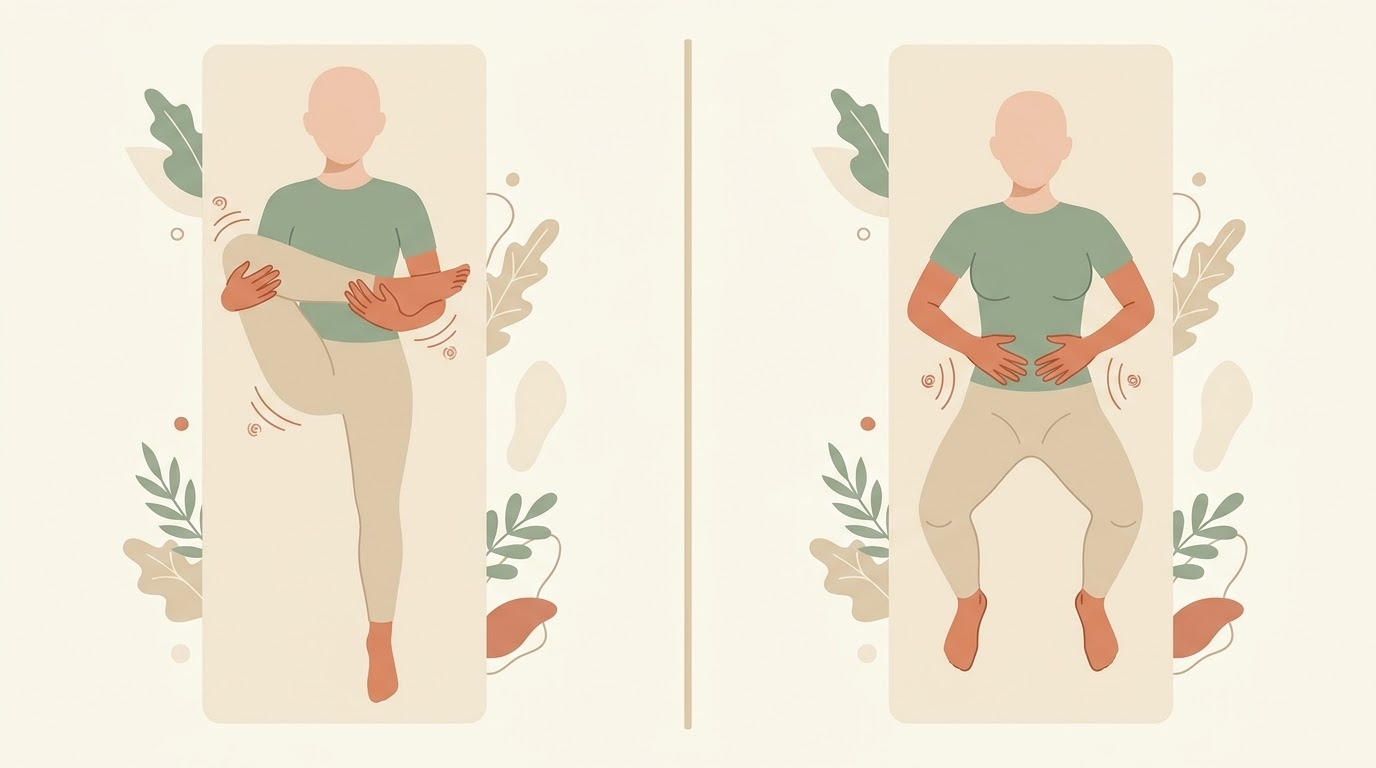
Lie on your back with your legs straight. Bend one knee and rotate the hip so the lower leg lies across your chest, pointing to the opposite side. The stretch lands in the thigh. Hold for 5 to 10 seconds, return to the start, and repeat 5 times with each leg.
3. Cat-cow
Start on all fours, hands under your shoulders and knees under your hips, back flat. As you breathe in, lift your collarbone and tailbone toward the ceiling and let your belly relax toward the floor, like a cow. As you breathe out, round your back, chin toward chest, tailbone tucked and navel pulled toward your spine, like a cat. Keep moving with your breath without holding, for 3 to 5 repeats.
4. Lower back press
Lie on your back with knees bent and feet on the floor. Gently flatten your lower back toward the floor, hold for 5 to 10 seconds, then relax. Repeat 5 to 10 times.
5. Bridging
Cleveland Clinic describes bridging as an exercise a physical therapist may teach you and show you how to do safely, so learn it with a professional first. Lie on your back with knees bent and feet flat, about hip-width apart. Tighten your belly and squeeze your buttock muscles, then lift your hips until your body makes a straight line. Hold for a few seconds and lower slowly.
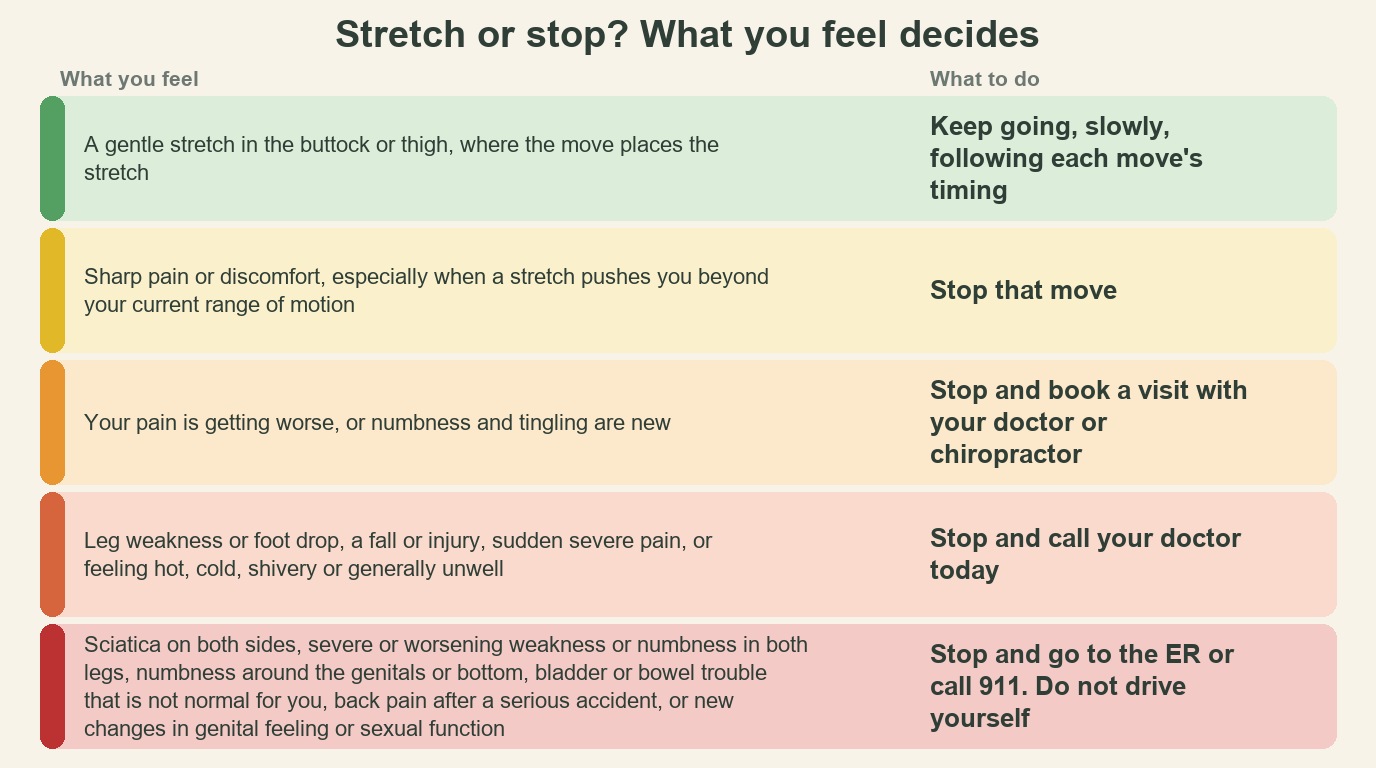
Stretch or Stop: What You Feel and What to Do
| What you feel | What it means for the stretch | What to do |
|---|---|---|
| A gentle stretch in the buttock or thigh, where the move places the stretch | What the sources describe for these moves | Keep going, slowly, following each move’s timing |
| Sharp pain or discomfort, especially when a stretch pushes you beyond your current range of motion | Too much for now (Harvard) | Stop that move |
| Your pain is getting worse, or numbness and tingling are new | The routine is not helping (NHS, NIAMS) | Stop and book a visit with your doctor or chiropractor |
| Leg weakness or foot drop, a fall or injury, sudden severe pain, or feeling hot, cold, shivery or generally unwell | Needs medical care (Cleveland Clinic, NIAMS) or urgent advice (NHS); we suggest the same day | Stop and call your doctor today |
| Sciatica on both sides, severe or worsening weakness or numbness in both legs, numbness around the genitals or bottom, bladder or bowel trouble that is not normal for you, back pain after a serious accident, or new changes in genital feeling or sexual function | A medical emergency (NHS) | Stop and go to the ER or call 911. Do not drive yourself |
What Can Make Sciatica Worse
Harvard lists heavy lifting, especially anything that asks you to bend or twist, as a common aggravator. It also names golf, tennis and yoga poses with sharp spinal rotation, and suggests skipping them “until sciatica pain subsides.”
Long sits matter as well. Cleveland Clinic names long sitting and frequent bending as strains on the lower back, and the NHS advises against sitting or lying down for long periods. If your day is a desk in Cool Springs or a long drive, get up and move regularly.
Heat and Ice
Cleveland Clinic says ice may help in the first few days and heat after that, for about 20 minutes at a time. Ask your doctor or pharmacist about medicine.
When Sciatica Needs a Doctor, Not a Stretch
Go to the ER or call 911 now. The NHS sciatica guidance lists these as emergencies:
- sciatica on both sides
- weakness or numbness in both legs that is severe or getting worse
- numbness around or under your genitals, or around your bottom
- trouble starting to pee, being unable to pee, or being unable to control it, if this is not normal for you
- not noticing when you need to poo, or being unable to control it, if this is not normal for you
- back pain that started after a serious accident, such as a car accident (NHS back pain)
- new changes in genital feeling during sex, or new trouble getting or keeping an erection or reaching orgasm (NHS back pain)
Do not drive yourself. Ask someone to drive you, or call 911.
Call your doctor today.
- weakness in a leg, including foot drop, where the front of the foot is hard to lift (Cleveland Clinic says weakness needs medical care; we suggest calling the same day)
- severe back pain that starts suddenly or is getting worse quickly, or feeling hot, cold, shivery or generally unwell (NHS urgent advice)
- back pain after a fall or injury (NIAMS says see a doctor; we suggest calling the same day)
Book a visit with your doctor or chiropractor.
- pain that has not improved after a few weeks of home care, is getting worse, or is stopping your normal activities (NHS)
- numbness and tingling with back pain, or severe pain that does not improve with medication (NIAMS)
- weight loss you did not intend (NHS)
What a Franklin Chiropractor Adds to a Stretch Routine
A stretch sheet is generic, and sciatica is not. In my practice, I start with your history and an exam, because the pattern decides everything. That tells us whether a stretch helps or aggravates it, whether gentle adjustments make sense, and whether you need a referral first. I played soccer professionally after a kinesiology degree in 2008, so I like moving people once I know it is safe.
NCCIH describes the same history, exam, tests and working diagnosis for chiropractors generally. For musculoskeletal pain like back pain and sciatica, we may treat with gentle adjustments alongside the movement you do at home. We also use the INSiGHT nervous system scan to measure nervous system function over time, though it does not diagnose sciatica.
For chronic sciatica, a 2025 network meta-analysis of 50 trials found the evidence “very uncertain” for any non-surgical option. So no one should promise you a result, and I will not. Our post on chiropractic safety explains what the research shows, and our sciatica care page describes a visit.
Frequently Asked Questions About Sciatica Stretches
Can a chiropractor help with sciatica?
It may, as one part of a plan. A chiropractor can examine which pattern you have, use gentle adjustments where they fit, teach you movement for home and refer you out when needed. The research on any single approach is uncertain, and no one can guarantee a result. Our sciatica page explains the visit.
Does sciatica go away on its own?
Often it improves without treatment. Cleveland Clinic says many cases improve within four to six weeks, and the NHS says it can last longer or come back. If it lasts beyond a few weeks or gets worse, talk with your doctor.
Which leg does sciatica affect?
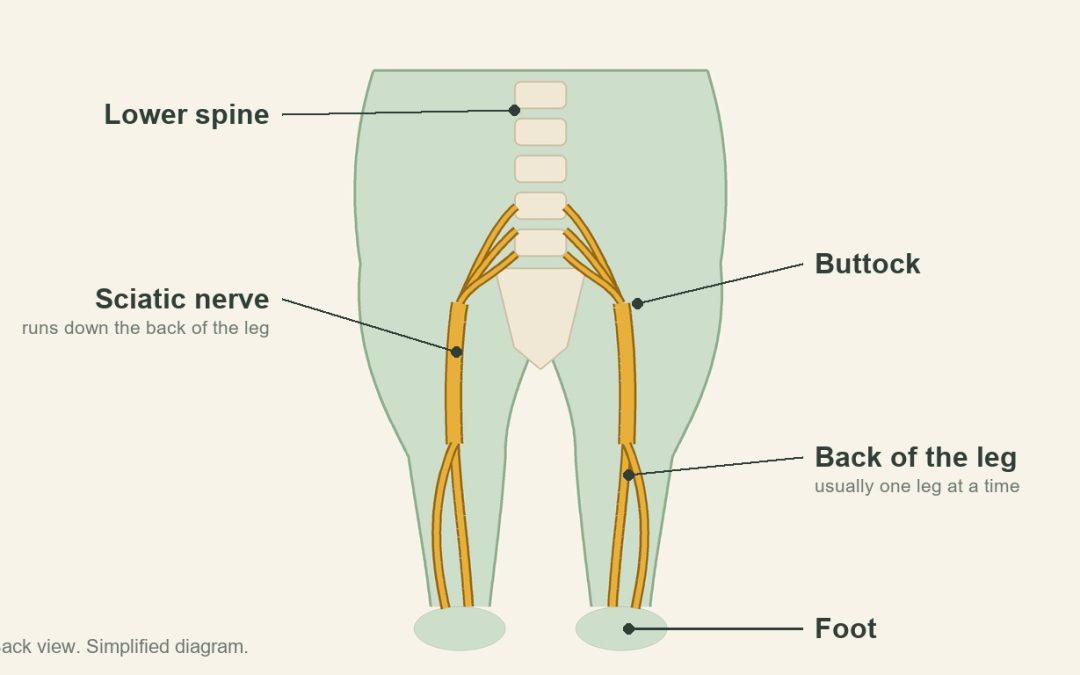
Sciatica usually affects one leg at a time, typically the buttock and the back of the leg, often including the foot and toes (NHS, Cleveland Clinic). Sciatica on both sides is different: it is an emergency sign, so go to the ER, and do not drive yourself.
What are the red flags for sciatica?
Go to the ER for sciatica on both sides, severe or worsening weakness or numbness in both legs, numbness around the genitals or bottom, or bladder or bowel trouble that is not normal for you. Do not drive yourself. Call your doctor today for leg weakness or foot drop, a fall or injury, sudden severe pain, or feeling unwell.
What can be mistaken for sciatica?
Cleveland Clinic describes “sciatica-like conditions” that feel the same but have other causes, involving nearby nerves or the group of nerves that form the sciatic nerve. It also says hip problems often cause pain in the groin. An exam is how those get told apart.
Book a Visit at Our Franklin Office
If your sciatica keeps coming back, come see me at 1261 Columbia Avenue in Franklin. You will have my full attention, an honest exam and a plan that fits your pattern, whether you come from Spring Hill or Brentwood. Book a consultation at our consultation page, schedule directly at our booking page, or call (615) 455-5350.
You can read more about me on the Dr. Anthony Putrus, DC bio page, and about chiropractic care in Franklin, TN. I would be glad to take a look.