
Low progesterone symptoms may include irregular periods, heavier bleeding, spotting, mood changes or anxiety, trouble sleeping, headaches and trouble conceiving. Other conditions cause the same signs, so symptoms alone cannot confirm it; a provider orders a blood test timed to your cycle. In pregnancy, call your OB-GYN about any bleeding: promptly, or right away if heavy or painful.
When a woman tells me her cycle feels shorter, her sleep thinner and the week before her period harder than it used to be, she usually expects one of two answers: that it is stress, or that it is hormones. Both can be true, and neither is a diagnosis.
What Progesterone Does in Your Cycle
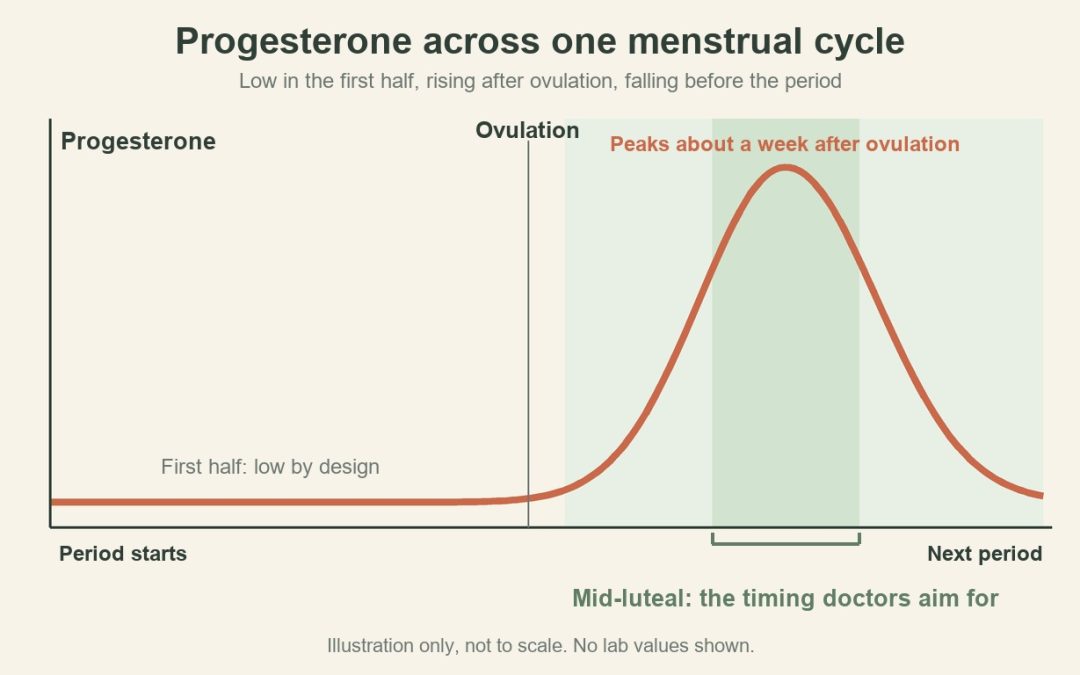
Think of progesterone as your cycle’s second-half signal. After an egg is released, the empty follicle, called the corpus luteum, makes progesterone. Cleveland Clinic puts its job this way: “In females, progesterone supports menstruation and prepares your uterus for pregnancy.”
If no pregnancy follows, progesterone falls and your period starts. If ovulation does not happen, that second-half signal is weak or missing, a shortfall also called progesterone deficiency.
Signs of Low Progesterone and What Else Can Cause Them
Progesterone is low by design in the first half of your cycle, so a shortfall is a second-half question. Cleveland Clinic lists these signs of low progesterone in women who are not pregnant: irregular periods, headaches, difficulty conceiving, mood changes, anxiety or depression, trouble sleeping, hot flashes, and bloating or weight gain. The table pairs them with what to log and what else can look the same.
| Sign | What to log | What else can cause it |
|---|---|---|
| Irregular or skipped periods | Day 1 of every period | PCOS, thyroid problems, perimenopause, high stress (ACOG, Cleveland Clinic) |
| Heavier bleeding | Pad or tampon changes on your heaviest days | Fibroids, polyps, bleeding disorders, some medications (ACOG) |
| Spotting | Dates and how long it lasts | Many causes; ACOG lists it as abnormal bleeding to report |
| Mood changes or anxiety | Mood by cycle day | Depression and anxiety disorders, perimenopause, thyroid disease (ACOG on PMS) |
| Trouble sleeping | Hours slept and cycle day | Many causes; ask your doctor |
| Headaches | Date and cycle day | Many causes; a doctor sorts them out |
| Trouble conceiving | Cycle length and ovulation signs | Ovulation problems and many other causes; a physician or OB-GYN sorts them out |
Symptoms that show up in the 5 days before your period, for at least three cycles in a row, and get in the way of daily life match how ACOG defines premenstrual syndrome. ACOG notes that depression, anxiety, perimenopause and thyroid disease can mimic or overlap with it, so a PMS pattern on its own does not point to low progesterone.
If you are pregnant or could be, any spotting or bleeding is a reason to call your OB provider promptly, and heavy or painful bleeding is a reason to call right away; the red flags below list the emergency signs.
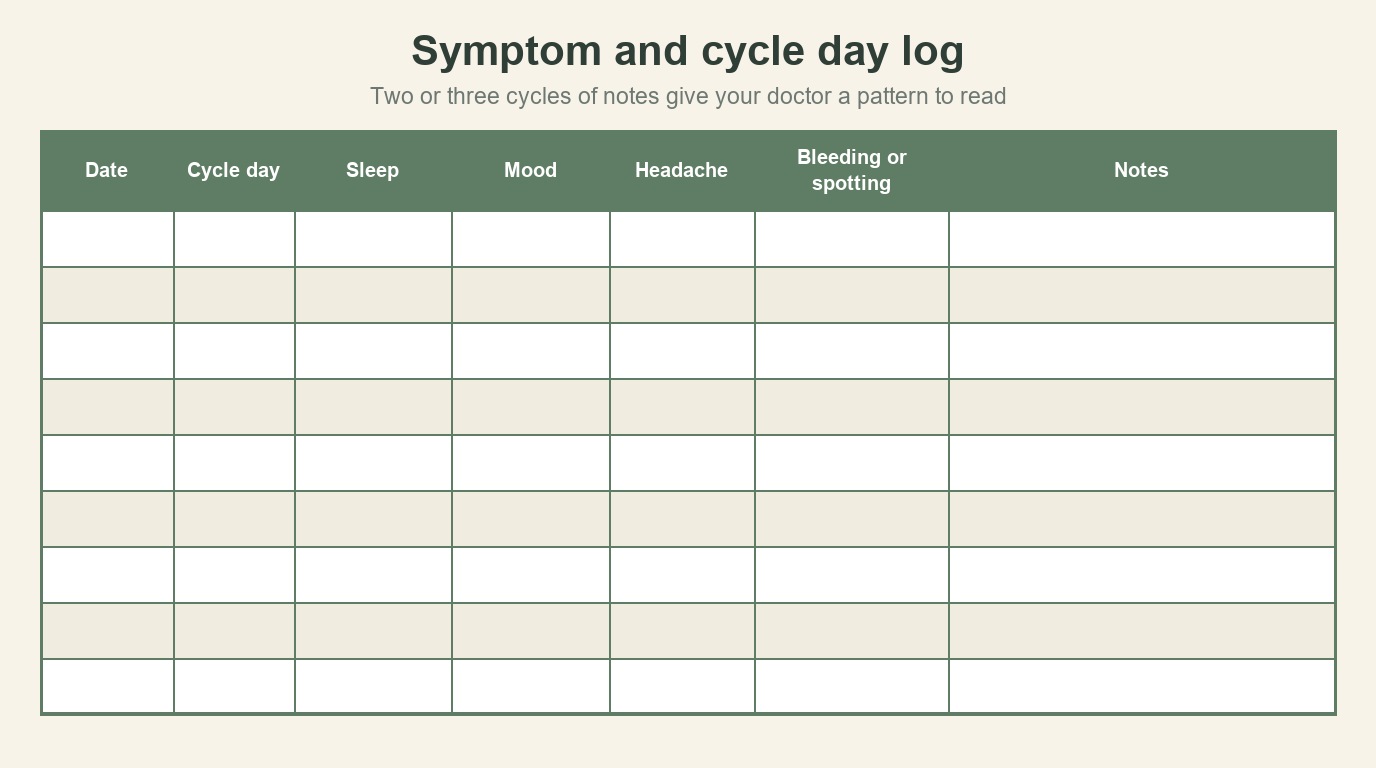
Keep a simple log and bring it to your appointment. ACOG gives the same advice when PMS is in question: rate your symptoms each day for at least 2 to 3 months and record your period dates.
Why Symptoms Alone Cannot Confirm Low Progesterone
Cleveland Clinic says it plainly: “Symptoms of low progesterone are similar to other conditions, so it’s important to talk to your healthcare provider for an accurate diagnosis.”
Irregular cycles are common. The National Institute of Child Health and Human Development (NIH) says 14% to 25% of women have irregular menstrual cycles, and that a typical cycle runs 21 to 35 days. The broader hormone symptom picture lives on our page about hormone imbalance symptoms in women.
Common Reasons Progesterone Runs Low
Cleveland Clinic names anovulation, a cycle where no egg is released, as the first of the most common causes. Its list continues with polycystic ovary syndrome (which it now calls PMOS), high stress, an underactive thyroid, high prolactin, low cholesterol, perimenopause, and over-exercising or extreme dieting.
In perimenopause, ACOG notes, cycles can get longer or shorter, periods can be skipped, and flow can turn lighter or heavier. In a study of 76 healthy women aged 21 to 55, each sampled through one cycle and grouped by reproductive stage (Hale and colleagues, Journal of Clinical Endocrinology & Metabolism, 2007), average luteal-phase progesterone was lower in the later stages of the menopause transition. It compared groups at one point in time and measured hormones, not symptoms. Our page on perimenopause support in Franklin goes further.
Life stage and lifestyle shift cycles too. NHS inform lists puberty, pregnancy, childbirth, breastfeeding, stress, weight gain, eating disorders and extreme exercise. Cleveland Clinic also says too much cortisol can interfere with making progesterone. The full stress story is on how stress and progesterone connect.
How Low Progesterone Is Checked: Why Timing Matters
Cleveland Clinic names a blood test as the way low progesterone is diagnosed. The same page explains that progesterone peaks about one week after ovulation, in the luteal phase, then drops before your period. A result can only be read against where you were in your cycle (MedlinePlus), so timing is the first question to ask your doctor.
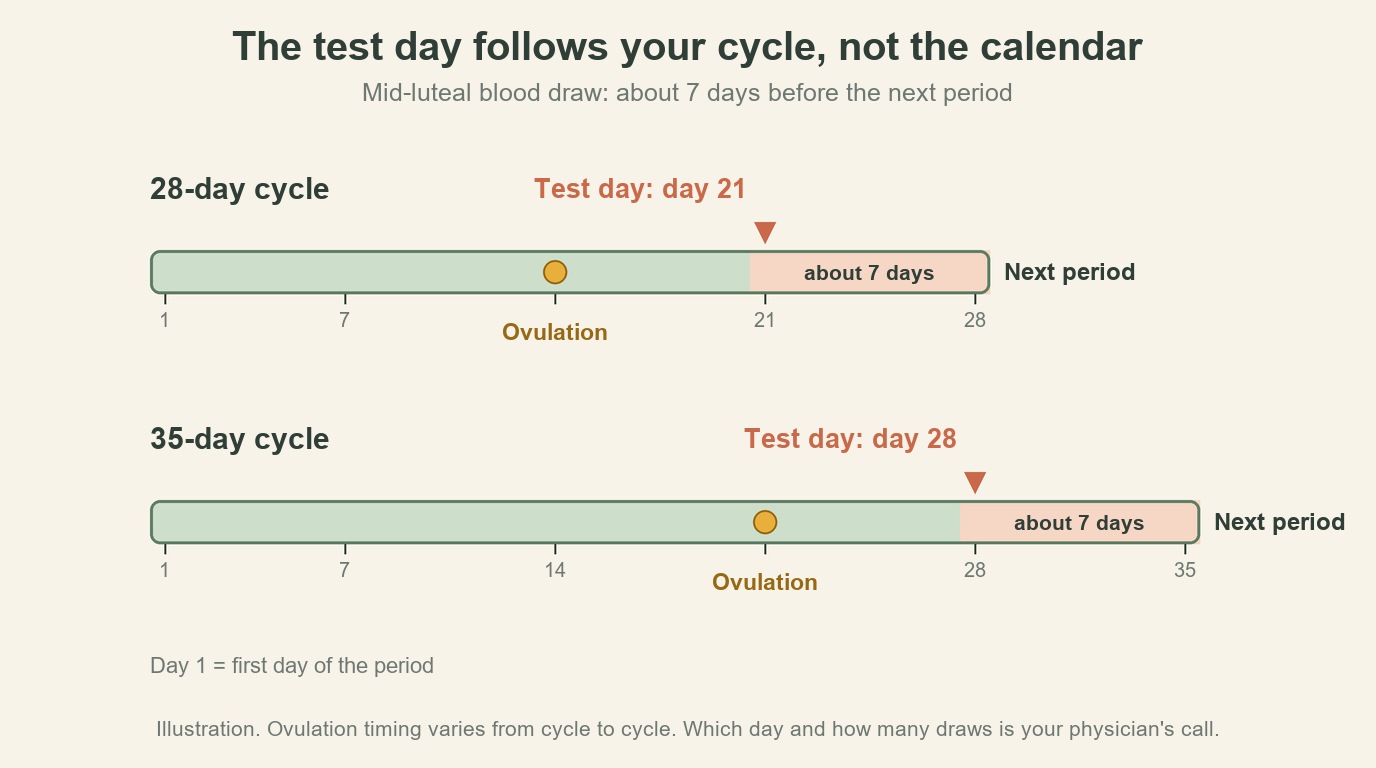
A hospital pathology service in the UK (University Hospitals of North Midlands NHS Trust) tells clinicians to sample in the mid-luteal phase, 7 days before the period starts: day 21 of a 28-day cycle, or day 28 of a 35-day cycle. For irregular or long cycles the same guidance suggests weekly measurements until the period begins. Which day, and how many draws, is your physician’s call.
One number is also a thin answer. A review by Mesen and Young (Obstetrics and Gynecology Clinics of North America, 2015) notes that progesterone is released in pulses, can fluctuate 8-fold within 90 minutes during the mid-luteal phase, and that a single value can neither diagnose nor exclude luteal phase deficiency, a second half of the cycle that is too short or makes too little progesterone. The American Society for Reproductive Medicine adds that luteal phase deficiency has not been proven to be an independent cause of infertility or recurrent pregnancy loss, and that experts still disagree on how to diagnose it (Fertility and Sterility, 2021).
The Healing Place also runs the DUTCH Complete, which collects dried urine across one day and reports progesterone metabolites alongside other hormones. It does not diagnose low progesterone; diagnosis stays with your physician. See how the DUTCH Complete works and our functional testing menu.
How We Support Hormone Questions at The Healing Place
In my practice, the women who reach me often arrive with normal results in hand and a cycle that tells a different story. We work from two directions: calming the nervous system, so the body is not stuck in a “go” state, and fueling the cells through nutrition and lifestyle support.
The INSiGHT scan at our Franklin office tracks heart rate variability, a measure of how well your body shifts out of stress mode. It cannot tell us anything about your progesterone level. We use it to see whether a stressed nervous system belongs in your plan, which stays alongside your physician’s care.
I lead functional medicine care at The Healing Place and oversee every case, and you can read more about Dr. Amy Putrus-Schnell, DC CFMP. Women come to see us from Brentwood and across Williamson County. Ours is a functional medicine practice in Franklin, TN that works alongside your doctor, never in place of one.
Red Flags: When Low Progesterone Symptoms Need a Doctor Now
Go to the emergency room or call 911 now if:
- you are changing pads or tampons every hour for more than 2 hours in a row, and you also have chest pain, shortness of breath, and lightheadedness or dizziness (ACOG)
- you could be pregnant and have sudden, severe pain in the abdomen or pelvis, shoulder pain, or weakness (ACOG on ectopic pregnancy)
Call your OB-GYN right away if you are or could be pregnant and:
- the bleeding is heavy, or comes with cramping like period pain (ACOG on early pregnancy loss)
- the bleeding comes with pain in the abdomen, pelvis or shoulder, which ACOG lists among the signs of ectopic pregnancy (ACOG on bleeding during pregnancy)
- you have any bleeding late in pregnancy; ACOG says to call right away or go to the hospital
Call your doctor or OB-GYN promptly if:
- bleeding soaks through one or more pads or tampons every hour, or lasts more than 7 days
- you bleed or spot between periods or after sex
- you have any bleeding after menopause
- you have gone around 3 to 6 months without a period and are not pregnant (ACOG, NHS inform)
- you are or could be pregnant and have spotting or bleeding without the signs above, a gush of fluid from the vagina, or passage of tissue; ACOG lists these as possible signs of miscarriage and says to call your OB-GYN about any bleeding in pregnancy (ACOG on early pregnancy loss, ACOG on bleeding during pregnancy)
Mention it at your next visit if:
- your cycle is irregular, or you have headaches, migraines, depression, anxiety or other mood changes (Cleveland Clinic)
- you are trying to conceive and have trouble with ovulation or regular cycles
Frequently Asked Questions
How can you tell if your progesterone levels are low?
Symptoms alone cannot confirm it. Your doctor can order a blood test, and because progesterone peaks about a week after ovulation, the day of the draw matters. MedlinePlus notes you may need to be tested several times, so ask which cycle day to test and how many draws you need.
What are the symptoms of low progesterone after menopause?
Cleveland Clinic notes that progesterone levels fall as you age and enter menopause. A symptom list proves little at this stage, so your doctor should sort out what you feel. ACOG lists any bleeding after menopause as abnormal, so call your doctor promptly if it happens.
Why does progesterone cause anxiety?
Cleveland Clinic lists anxiety and mood changes among low progesterone symptoms and counts mood among progesterone’s roles, but it does not explain how one leads to the other. ACOG notes that anxiety disorders are among the most common conditions that overlap with premenstrual symptoms. Your doctor can help you sort out which is which.
Can low progesterone cause irregular periods?
Yes, irregular periods are the first sign Cleveland Clinic lists. Progesterone depends on ovulation, and when no egg is released, cycles can run irregular and sometimes heavy, ACOG notes. Irregular cycles also come from PCOS, thyroid problems, perimenopause and stress, so testing and a physician’s review come first.
What can I do about low progesterone symptoms?
Start with your physician, who decides on testing and any medical care. Tracking 2 to 3 months of cycles gives that visit more to work with. If you are or could be pregnant, call your OB-GYN promptly about any bleeding, and right away if it is heavy or painful. For herbs, see herbs people ask about for progesterone.
Is it possible to have low progesterone and normal periods?
Yes. In a study of 259 regularly menstruating women followed for up to two cycles, about 8% of ovulatory cycles showed low luteal progesterone (5 ng/mL or less), and it repeated in only 5 women (Schliep and colleagues, 2014). The study tracked hormones, not symptoms. Ask your doctor whether a well-timed blood draw makes sense for you.
Bring Your Cycle Questions to Our Franklin Office
Your log is where we start. Under my direction, our care team will read it with you at 1261 Columbia Avenue in Franklin, next to your cycle dates and the results your physician or OB-GYN has already run. We will be clear about what your notes point to and what only a lab can answer.
Start with a consultation, or call (615) 455-5350 to book a first visit. Bring two or three cycles of notes.
