
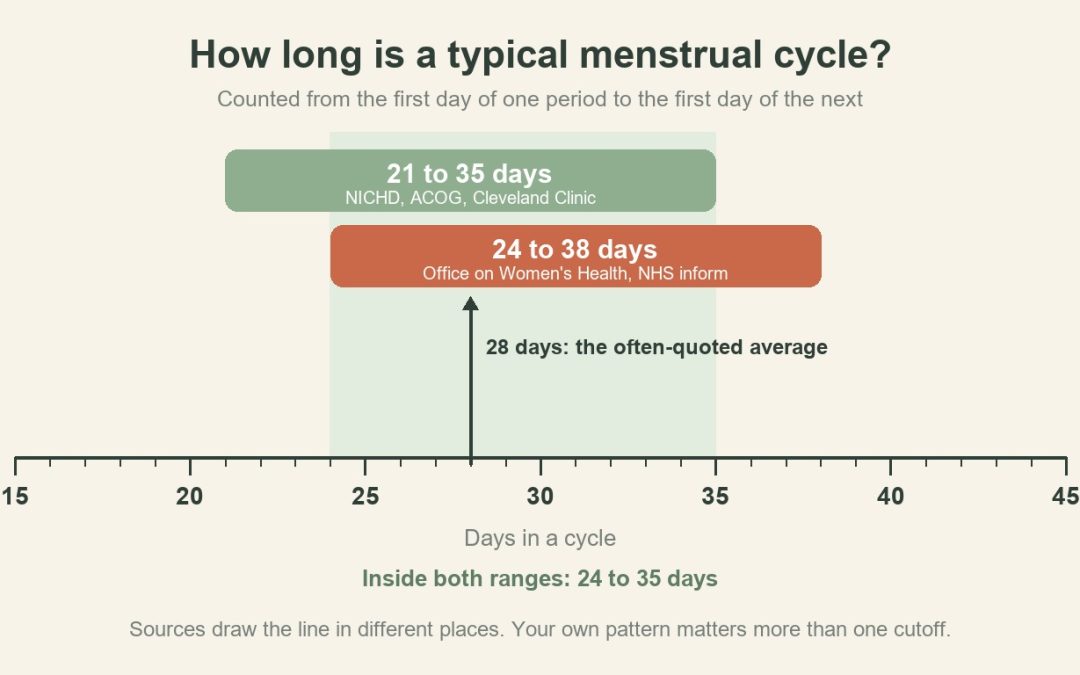
Irregular periods are cycles outside your normal pattern: shorter than 21 days, longer than 35, or varying a lot. Common causes include stress, weight change, extreme exercise, thyroid problems, PCOS, perimenopause, birth control and pregnancy. See your doctor for no period in three months, very heavy bleeding, or bleeding between periods, after sex or after menopause.
One of the first things I ask a woman about her cycle is not how long it is. I ask how it behaves: whether it runs late and then catches up, whether the gaps are getting wider, whether it changed the same season something else in life did. A number like “my cycle is 32 days” sounds like an answer, but the shape of the change over several months is the part that points somewhere.
Your period was due last week, and you cannot remember the last time it arrived when the calendar said it would. That is frustrating, and it does not mean you are doing anything wrong. Sorting out the cause is a job for your physician or OB-GYN, and I encourage the woman I see to bring her dates to that appointment; ACOG recommends the same.
What Counts as an Irregular Period?
Your menstrual cycle runs from the first day of one period to the first day of the next. The National Institute of Child Health and Human Development (NICHD) says a normal cycle ranges from 21 to 35 days for most women, with an average of 28 that varies between women and from month to month. The American College of Obstetricians and Gynecologists (ACOG) counts cycles longer than 35 days or shorter than 21 as abnormal patterns, along with cycles whose length varies by more than 7 to 9 days.
Sources draw the edges a little differently. The Office on Women’s Health calls periods regular when they usually come every 24 to 38 days, and NHS inform gives the same 24 to 38 span. A 36-day cycle is long by one measure and inside the range by another, so your own pattern matters more than a single cutoff.
Doctors use a few names for these patterns. NICHD defines oligomenorrhea as periods more than 35 days apart, polymenorrhea as periods less than 21 days apart, and amenorrhea as no period for at least 3 months when you are not pregnant. ACOG also counts bleeding that lasts more than 7 days as abnormal.
Which Kind of Irregular Is Yours? A Pattern-to-Cause Guide
Why is my period irregular? Find the row that sounds most like your last few months, then use the last column to prepare for your appointment. This is a guide to the questions worth asking and never a diagnosis, because every cause in it needs a clinician to confirm.
| Your pattern | What it looks like | Causes the sources most often name | Ask your doctor about |
|---|---|---|---|
| Long or skipped cycles | Periods more than 35 days apart, or months with none | Pregnancy or breastfeeding; PCOS; an underactive or overactive thyroid; high prolactin; a large weight change; very intense exercise or an eating disorder; long-lasting stress; perimenopause | A pregnancy test first, then blood work that looks at thyroid and prolactin |
| Short or frequent cycles | Periods less than 21 days apart (NICHD) or closer than every 24 days (Office on Women’s Health) | Thyroid problems (one review links an overactive thyroid with more frequent periods); perimenopause; starting or stopping hormonal birth control; problems with ovulation | Whether your age, your thyroid or a medication change fits the pattern |
| Unpredictable cycles | Length swings by more than 7 to 9 days (ACOG) or more than 20 days (NICHD) | The first years of periods; perimenopause; stress or routine changes; PCOS; thyroid problems | Whether the swings fit your life stage and what else to rule out |
| Heavy or long bleeding | Soaking a pad or tampon every hour, or bleeding past 7 days (ACOG) | Problems with ovulation; an underactive thyroid; fibroids or polyps; adenomyosis; bleeding disorders; some medications such as blood thinners | A call to your doctor, since this pattern is on the red-flag list below |
| Spotting between periods or after sex | Bleeding or spotting outside your period | Breakthrough bleeding on hormonal birth control; polyps; infection; pregnancy-related causes; rarely cancer | An exam, since bleeding after sex is on the red-flag list below |
Common Causes of Irregular Periods
Pregnancy and breastfeeding
If your period is late and pregnancy is possible, take a pregnancy test; NHS inform advises doing so as soon as possible. It also notes that most women do not have periods while exclusively breastfeeding. If a test is positive and you have spotting or pain, call your OB provider, because ACOG lists ectopic pregnancy and miscarriage among the causes of abnormal bleeding.
Puberty and perimenopause
In the first years after periods begin, cycles often run long and uneven, and the Office on Women’s Health says girls usually become more regular within three years. If you are in your 40s and your cycle is changing, our page on perimenopause symptoms goes deeper.
Stress and routine changes
Cleveland Clinic says disruptions or changes in your daily routine can have an impact on your cycle, and it names stress as a lifestyle factor. A season of school drop-offs in Brentwood, work deadlines and short nights counts as a routine change too.
Weight change and eating disorders
The Office on Women’s Health says gaining or losing a large amount of weight can change your cycle, and that eating disorders of any kind are a recognized cause. If food, eating or how you feel about your body has become a struggle, tell your doctor; this is a health topic and never a character flaw.
Very intense exercise
Cleveland Clinic lists exercise routines that lead to very low body fat, such as those of long-distance runners, dancers and gymnasts. The Endocrine Society’s guideline on functional hypothalamic amenorrhea (Gordon et al., 2017) ties the condition to stress, weight loss, excessive exercise, or a combination, and calls it a diagnosis of exclusion, so a doctor rules out other causes first.
Hormonal birth control starting or stopping
Going on or off hormonal birth control can affect your cycle, and Cleveland Clinic says irregular or missed periods can last for up to six months after stopping the pill. Questions about starting, stopping or switching belong with your prescriber. Please do not change anything on your own.
PCOS
Polycystic ovary syndrome (PCOS) is a hormonal condition that can cause irregular periods, and the Office on Women’s Health says about 1 in 10 women with irregular cycles has it. Diagnosis follows international criteria that a clinician applies (Teede et al., Fertility and Sterility, 2023), so it is a physician’s call. Our page on PCOS symptoms covers what many women notice.
Thyroid disorders
An underactive or overactive thyroid can both change your cycle. Krassas and colleagues (Endocrine Reviews, 2010) report that hypothyroidism is associated mainly with infrequent periods, while an overactive thyroid is associated mainly with lighter or more frequent ones (the Office on Women’s Health describes fewer, lighter periods). ACOG lists hypothyroidism among the conditions that can interrupt ovulation, and our page on thyroid symptoms in women lists the signs to bring up.
High prolactin
Prolactin is a pituitary hormone best known for milk production after childbirth, and the Office on Women’s Health says it also helps control the menstrual cycle. NICHD lists elevated prolactin as a cause of irregular periods. Blood work ordered by your clinician is how this one gets checked.
Medications and other medical conditions
Cleveland Clinic names steroids and blood thinners, and NICHD notes that some medications for epilepsy or mental health can change cycles. Fibroids, polyps, endometriosis, pelvic infection and bleeding disorders can also change bleeding patterns (ACOG, NHS inform), so a pattern that keeps changing deserves a medical look.
What to Track Before You See Your Doctor
ACOG has called the menstrual cycle a vital sign for girls and teens (Obstetrics & Gynecology, 2015), and your log is how you read it at any age. ACOG suggests tracking for several weeks before your visit, noting the dates, length and type of bleeding. Keep it somewhere you already look every day, such as a notes app on your phone.
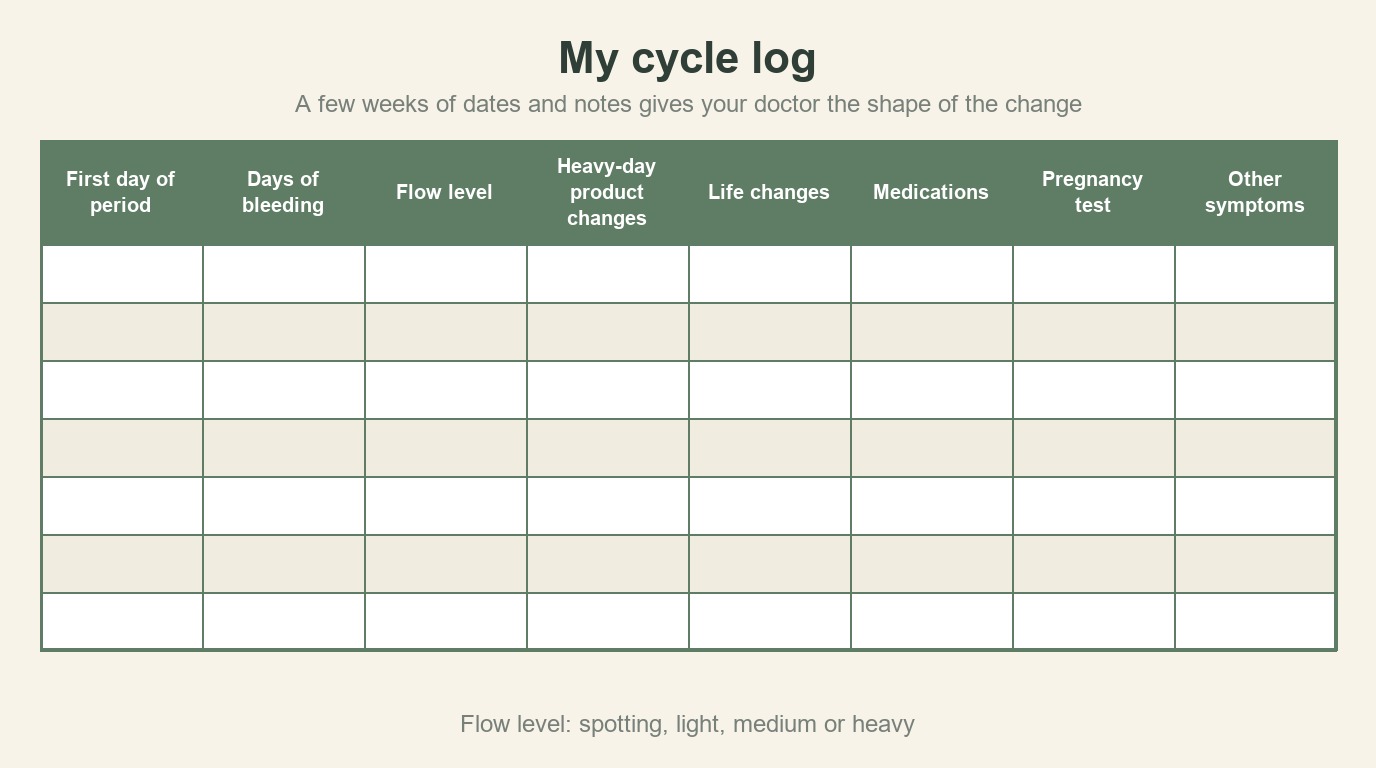
| Write down | How | Why your doctor wants it |
|---|---|---|
| First day and length of each period | Mark the day bleeding starts and count the days | Gives your cycle length from start to start, and shows whether bleeding runs past about a week |
| Amount of bleeding | Label each day spotting, light, medium or heavy | Separates spotting from a true period |
| Heavy-day product changes | Note how often you change a pad or tampon | Flags bleeding that soaks through every hour |
| Life changes | Note sleep, stress peaks, travel, illness, training and weight changes | Lines your cycle up against your life |
| Medications and birth control | Write the names and the start or stop dates | Medications and contraception can shift cycles |
| Pregnancy tests | Record the date and the result | Rules out the first cause on every list |
| Other symptoms | Pain, bleeding between periods, bleeding after sex | Points to which causes need a closer look |
The Stress and Nervous System Piece: How a “Go” State Can Shift Your Cycle
Stress is one of the causes the sources name most often. The Office on Women’s Health says studies show high levels of chronic stress can lead to irregular periods, and that long-term, severe stress can affect the part of the brain that controls reproduction, so that ovulation and your period can stop.
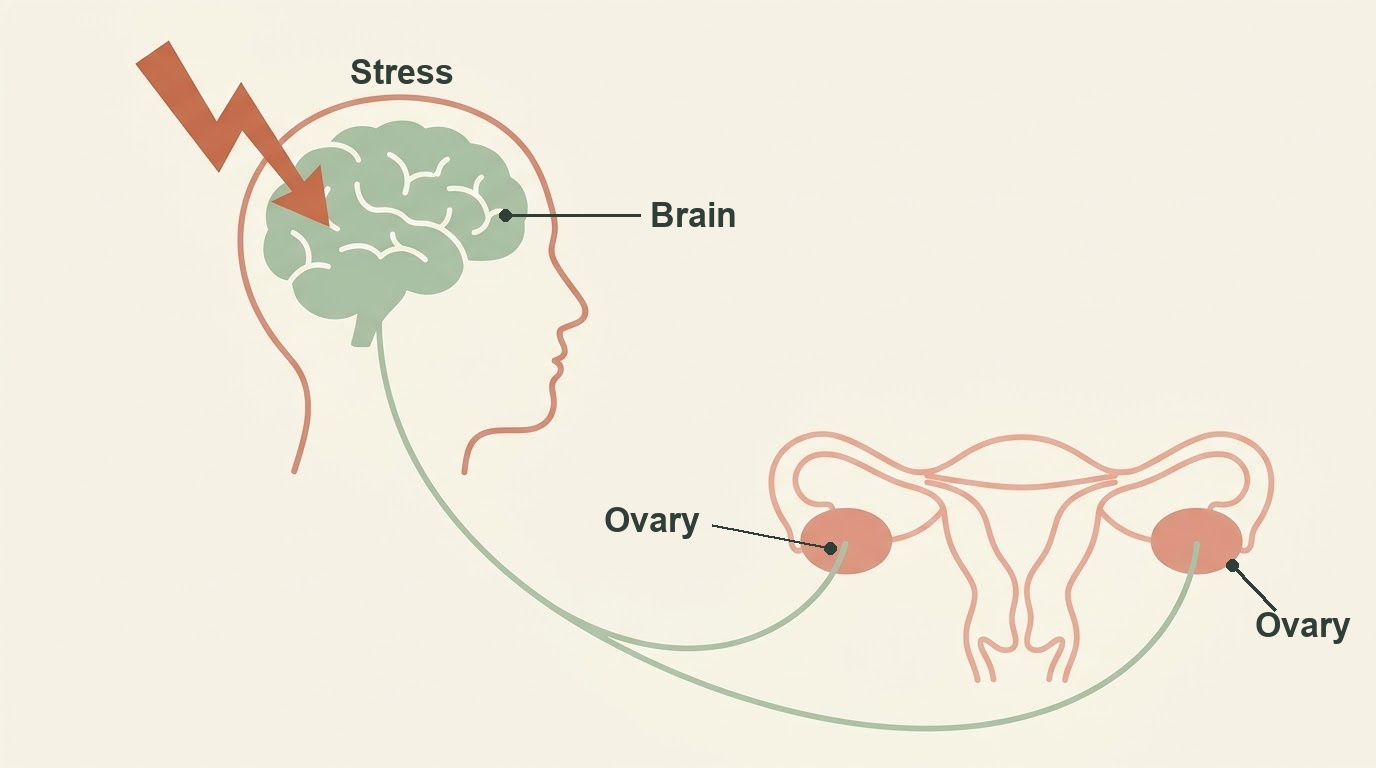
When your body spends long stretches in survival mode, the timing of ovulation may shift, and ACOG notes that a lack of ovulation can cause irregular, sometimes heavy, bleeding.
This is where I look at the nervous system: the INSiGHT scan at our Columbia Avenue office measures heart rate variability (HRV), a window into how well your body recovers from stress, along with muscle tension. It does not diagnose a cycle problem; it adds one more piece of information to a supportive plan that sits next to your doctor’s care. You can read about my background on the Dr. Amy Putrus-Schnell, DC CFMP bio page.
For the hormone side of this story, how stress and progesterone connect has its own page.
How Hormone Pattern Testing Fits (and What It Cannot Do)
A doctor works out the cause of irregular periods with your history, an exam, blood work, and imaging such as an ultrasound when it is needed (NICHD, ACOG). That is the front door, and it comes first. Pregnancy tests, thyroid and prolactin checks, and any imaging belong with your physician or OB-GYN.
The Healing Place also offers the DUTCH Complete, which looks at your hormones and their breakdown products, called metabolites, in dried urine samples collected across one day. It does not diagnose PCOS, thyroid disease or any cause of irregular periods; it is information we use to shape a supportive plan and share with your doctor.
To see what the test looks at, read what a DUTCH test can show, or see a functional medicine approach to hormones.
When to See Your Doctor About Irregular Periods
NHS inform says that most of the time there is no need to worry. Call your doctor or OB-GYN if you have:
- A positive or possible pregnancy along with spotting or pain. Call your OB provider; ectopic pregnancy and miscarriage are among the causes of abnormal bleeding (ACOG).
- No period for 3 months when you are not pregnant, breastfeeding or in menopause. Cleveland Clinic says the absence of a period for 90 days or more is considered abnormal in that situation, and ACOG lists 3 to 6 months without a period.
- Bleeding that soaks through one or more pads or tampons every hour, or bleeding that lasts more than 7 days (ACOG).
- Passing clots larger than a quarter (Cleveland Clinic, Office on Women’s Health).
- Feeling dizzy, lightheaded, weak or tired, or having chest pain or trouble breathing during or after your period, which can be signs of anemia (Office on Women’s Health).
- Bleeding between periods, bleeding after sex, or any bleeding after menopause (ACOG, NHS inform).
- Severe pain or cramping during or between periods, or nausea or vomiting during your period (Cleveland Clinic).
- Foul-smelling vaginal discharge (Cleveland Clinic).
- No first period by age 15, or none within three years after breast growth began (Office on Women’s Health).
- Periods that become irregular after you had regular cycles, or that come more often than every 24 days or less often than every 38 (Office on Women’s Health).
- Fever, vomiting, diarrhea, fainting or dizziness while using tampons or pads, which Cleveland Clinic lists as symptoms of toxic shock syndrome.
ACOG advises emergency medical care right away if you are changing pads or tampons every hour for more than 2 hours in a row and also have chest pain, shortness of breath, and lightheadedness or dizziness. If you are unsure, call 911 or go to the nearest emergency room.
Frequently Asked Questions
What are the main causes of irregular periods?
Pregnancy is the first thing to rule out, with a test. After that, the sources most often name stress, large weight changes, intense exercise, PCOS, thyroid problems, high prolactin, perimenopause, hormonal birth control and certain medications. Many people fit more than one cause, so a doctor confirms which applies to you.
How can I get my period back on track?
What helps depends on the cause, so the first step is finding out what is behind it with your doctor. When stress, training load or rest are part of the picture, Cleveland Clinic lists enough rest, stress-reduction practices, cutting back on prolonged or intense exercise, and losing weight gradually rather than through severely restrictive diets as self-care.
When should I worry about my irregular period?
Call your doctor if you go three months without a period when you are not pregnant, or have bleeding that soaks a pad or tampon every hour, between periods or after sex. ACOG advises emergency care when hourly soaking lasts over 2 hours and you also have chest pain, shortness of breath, and lightheadedness or dizziness.
Do irregular periods go back to normal?
It depends on the cause, so ask your doctor. Puberty can take up to 2 years to settle (NHS inform), skipped periods are common in perimenopause (ACOG), and cycles can take up to six months to settle after stopping the pill (Cleveland Clinic).
How much delay in a period is normal?
Cleveland Clinic says slight delays are typically OK, and a cycle does not need to arrive on the exact predicted day to count as normal. A sudden change in the time between cycles or in how long a period lasts is worth a call to your provider. So is any late period when pregnancy is possible.
Can stress cause irregular periods?
Yes. The Office on Women’s Health, Cleveland Clinic and NHS inform all name stress as a cause, and the Office on Women’s Health says long-term, severe stress can affect the brain’s control of reproduction so that ovulation and your period stop. The Office on Women’s Health adds that managing stress can help when stress is the cause.
Is it normal to miss a period for two months?
Cleveland Clinic says skipping one or two periods is not ideal but not too concerning, and it suggests looking at recent changes such as stress, a new workout routine, weight change or a birth control change. Take a pregnancy test if pregnancy is possible. Call your provider if you miss your period for three or more months in a row.
Getting Started With Your Cycle Questions in Franklin
Your cycle has been giving you information, and you have been carrying it around by yourself. Our functional medicine team would be glad to sit down with your cycle log at our office at 1261 Columbia Avenue in Franklin, and look at your sleep, your stress and your history alongside the physician or OB-GYN you already see. We welcome women from Cool Springs too. Under my direction, we start with your nervous system and your whole-body picture and work alongside your doctor.
Begin with a consultation, and see how functional medicine in Franklin, TN works here. Our overview of hormone imbalance symptoms in women is a good companion read. Call (615) 455-5350 or schedule your first visit, and bring the cycle log along.
