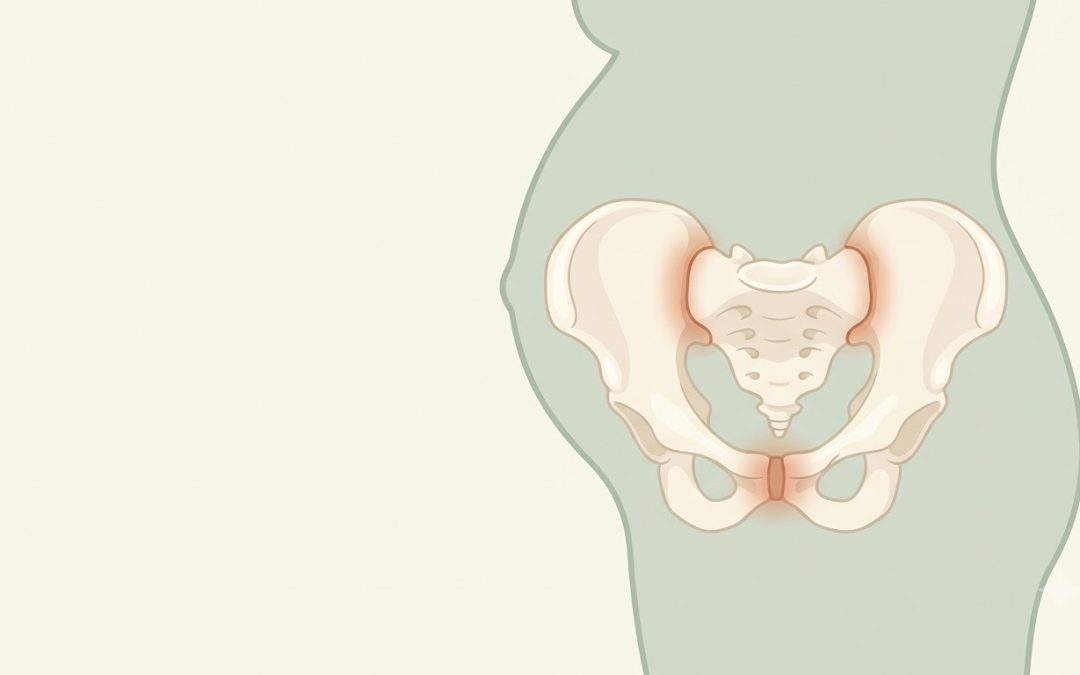
Pelvic pain during pregnancy is often pelvic girdle pain: pain in the joints at the back or front of the pelvis, felt in the lower back, hips, buttocks or pubic bone. About one in five pregnant women is affected. Movement, support and pregnancy-adapted care may ease it; bleeding, fever or severe pain that will not ease means call your OB right away or go to the hospital.
What I listen for first, when a pregnant mom describes pain at the front of her pelvis, is the exact moment it flares. Was she stepping out of the car, climbing the stairs, or lifting one leg to pull on her jeans? That moment tells me more than the word “pain” ever could.
What Pelvic Girdle Pain Is, and What It Is Not
Pelvic girdle pain, often shortened to PGP, is a joint problem more than a muscle strain you can stretch away. The European guideline on pelvic girdle pain (Vleeming and colleagues, European Spine Journal, 2008) defines it as “a specific form of low back pain (LBP) that can occur separately or in conjunction with LBP.” It generally arises in relation to pregnancy, trauma or arthritis.
Your pelvic girdle is made up of the pubic symphysis, the sacrum and the hip bones, according to Cleveland Clinic’s symphysis pubis dysfunction page (medically reviewed, updated August 2024). The pubic symphysis is the joint at the front that connects your left and right pubic bones. At the back, the sacrum meets the hip bones at the sacroiliac joints.
The NHS page on pelvic pain in pregnancy (reviewed December 2022) lists where women feel it: over the pubic bone, across one or both sides of the lower back, between the vagina and anus, and spreading to the thighs. The same page states that PGP is not harmful to your baby, although it can make getting around hard.
How common is pelvic girdle pain in pregnancy? The guideline puts the point prevalence at about 20% of pregnant women, and a 2024 meta-analysis in Health Science Reports (PubMed record) notes that published estimates run between 20% and 70%. A systematic review by Wu and colleagues in the European Spine Journal (2004) found that among women with pregnancy-related pelvic or low back pain, serious pain occurs in about 25% and severe disability in about 8%.
If your pain is a brief, sharp pull low on the side of your belly, that points toward round ligament pain in pregnancy, which is a different problem with its own post.
Why the Pelvis Hurts More in Pregnancy
ACOG’s guidance on back pain during pregnancy (last reviewed October 2025) explains that a hormone loosens the ligaments in your pelvic joints to prepare for birth, and that pain can follow if the joints become too flexible. Cleveland Clinic names that hormone as relaxin. Looser joints serve birth well, yet they also carry more weight each month.
No single cause explains every case. The NHS notes that it is not known exactly why some women are affected, and links PGP to earlier damage to the pelvis, pelvic joints moving unevenly, and the weight or position of the baby. The guideline adds that a history of low back pain and previous pelvic trauma are the most probable risk factors, and Wu’s review lists strenuous work as another.
For pain centered in the lower back, see our back pain care page.
Signs It May Be Pelvic Girdle Pain: A Short Self-Check
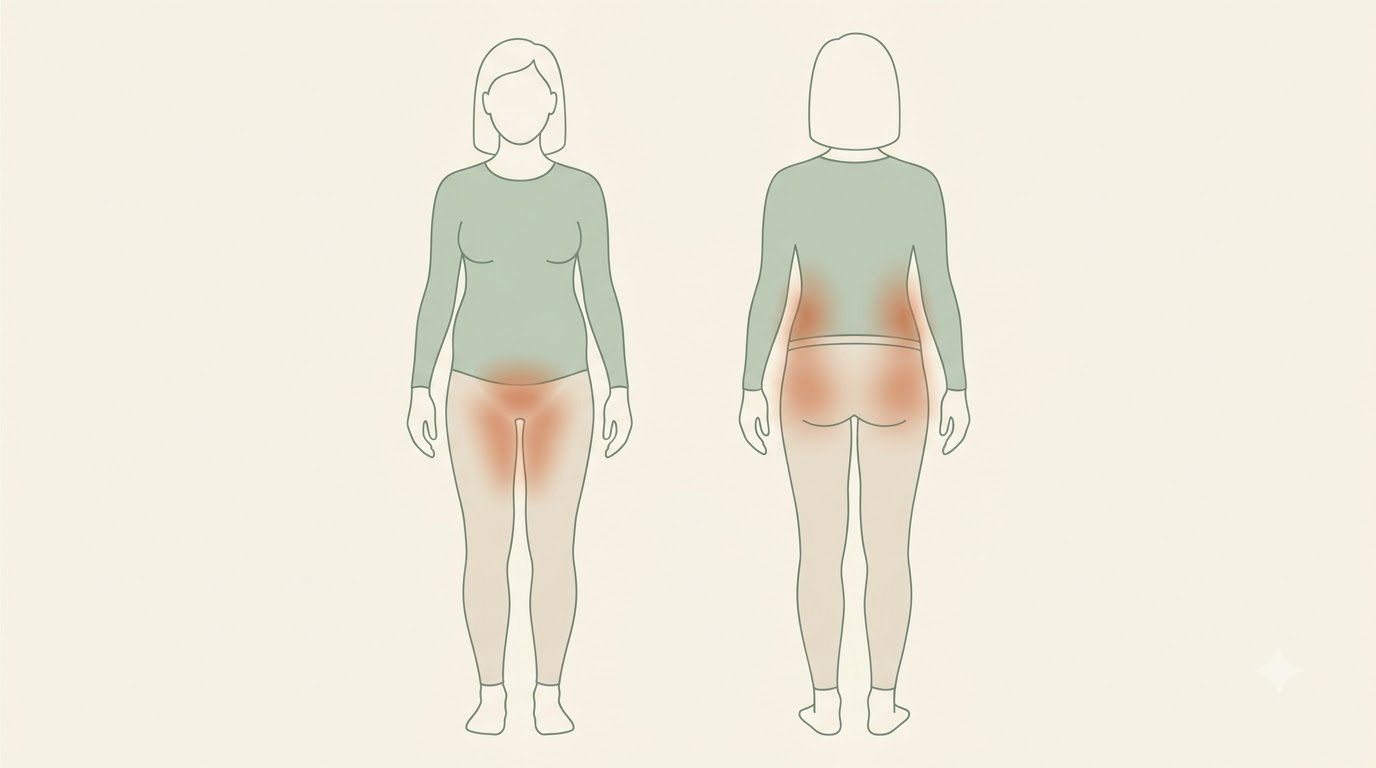
Use the table below to put words to your pain, not to diagnose it. Each row follows wording from the NHS, Cleveland Clinic and the European guideline.
| Where it shows up | What tends to set it off | How it can feel | Worth telling your provider |
|---|---|---|---|
| Front of the pelvis, over the pubic bone | Walking, stairs, standing on one leg, moving your legs apart | Mild ache, sudden shooting pain, a loose, wobbly feeling, or clicking | Which movements flare it and how quickly it settles |
| One or both sides of the low back, or the buttock | Turning over in bed, rising from a chair, standing for a long stretch | Deep ache across the back of the pelvis | Whether one side is worse than the other |
| Groin, thigh, or the area between vagina and anus | Walking, getting in and out of the car | Steady or spreading pain | Whether it travels, and any change in bladder or bowel habits |
Clinicians do not guess from the pattern alone. The European guideline says PGP can be diagnosed with pain-provocation tests (such as the thigh-thrust test, Patrick’s FABER and Gaenslen’s test) and by pressing on the pubic symphysis and the ligaments at the back of the pelvis. The same guideline does not recommend X-rays or CT scans for diagnosis.
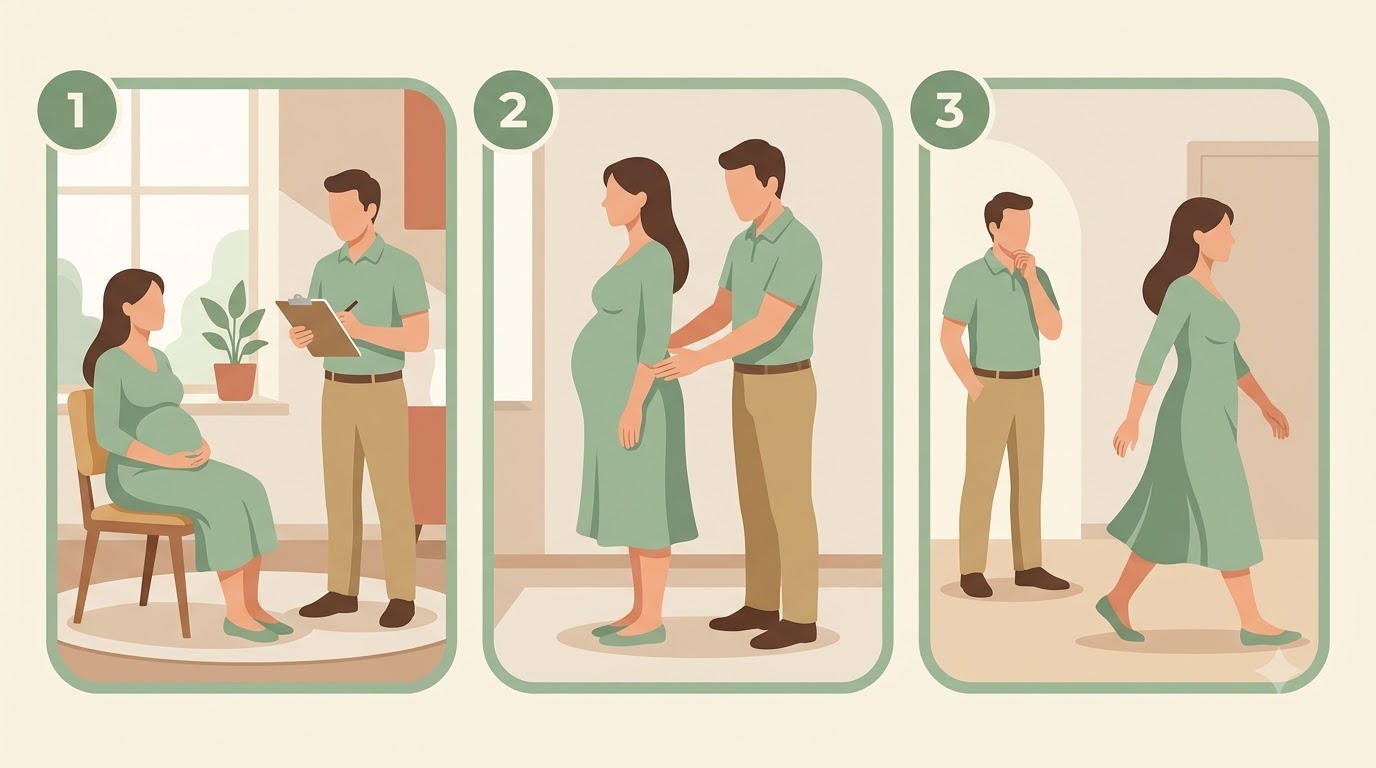
In my practice, an exam follows the same logic: your history, then orthopedic tests, then how you stand and walk.
Gentle Ways to Ease Pelvic Girdle Pain at Home
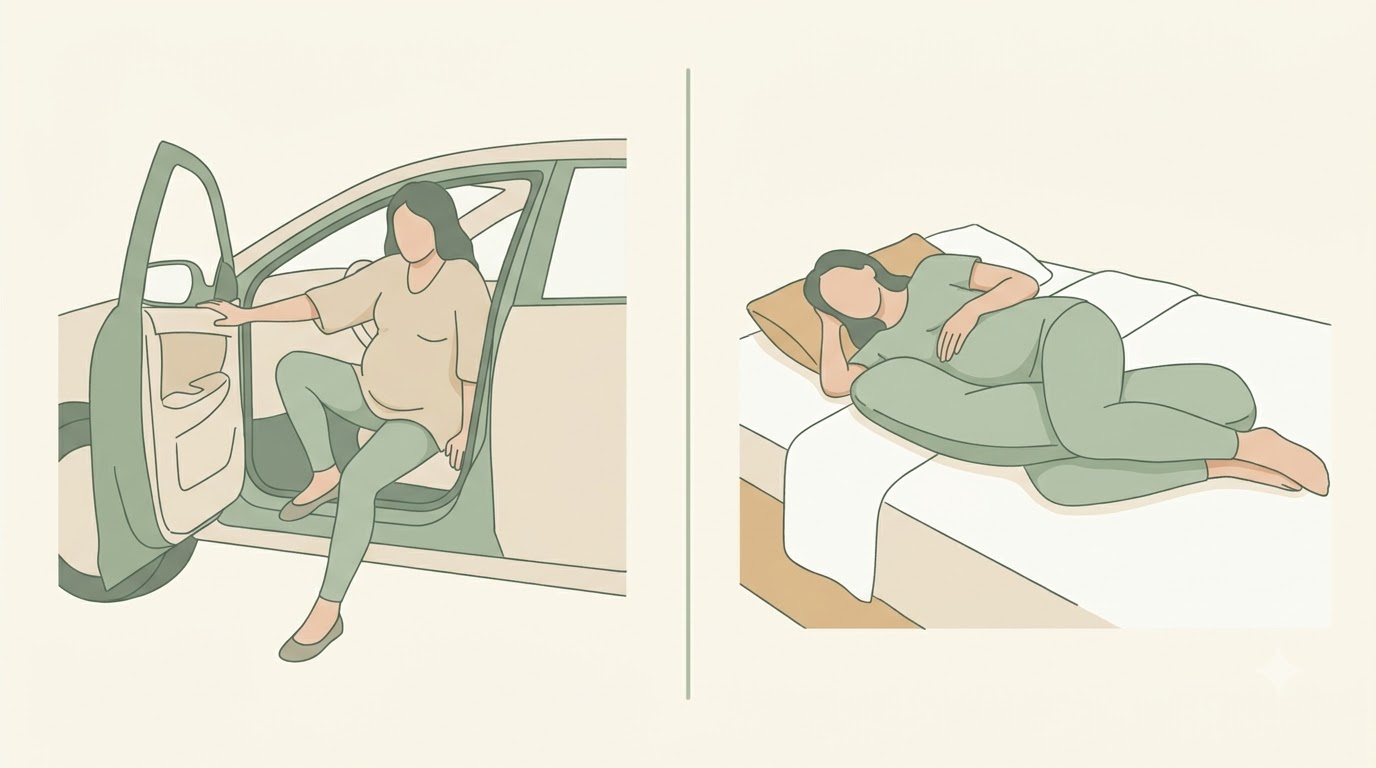
The guideline’s recommended foundation is plain: good information and reassurance, plus exercise individualized to the pregnant woman. ACOG adds that once other causes are ruled out, your ob-gyn may suggest a rehabilitation specialist or physical therapist. Everything below is a starting point to discuss with that team.
- Squeeze your knees together when you get out of the car; both the NHS and Cleveland Clinic suggest it.
- Put equal weight on each leg when you stand, and sit down to get dressed (NHS).
- Lie on one side at night, a pillow tucked between your knees and lower legs (Cleveland Clinic).
- Choose low-heeled, not flat, shoes with good arch support (ACOG).
- Lift by squatting with bent knees and a straight back, and pass heavy shopping bags to someone else (ACOG, NHS).
- Try a short session of heat or cold on sore areas, wrapped in a towel, as ACOG describes.
The NHS also advises avoiding long spells of sitting or standing and skipping extra trips up and down stairs. If your day includes a long drive, whether you live in Brentwood or right here in Franklin, plan a stop to stand and walk a little.
Support belts get a cautious verdict. ACOG, Cleveland Clinic and the NHS all mention a maternity girdle or pelvic belt. In a Spine trial (Elden and colleagues, 2005, 118 women), every woman received a nonelastic sacroiliac belt and information, and adding home or clinic exercise gave no extra benefit, although pain eased in all groups. With no belt-free group, that trial cannot tell us whether the belt itself helped.
Exercise gets a mixed verdict too. A 2019 review in the British Journal of Sports Medicine (PubMed record, 32 studies) concluded that prenatal exercise lowered the severity of low back, pelvic girdle or combined pain but did not lower the odds of having it. The Cochrane review (Liddle and Pennick, 2015) rated the evidence as moderate to low quality and found moderate-quality evidence that an 8 to 12 week program reduced the number of women reporting low back and pelvic pain together.
Walking is generally safe in pregnancy and water exercise can be especially helpful for back pain, per ACOG. Check with your OB or midwife before you start anything, and stop any exercise that causes pain.
Chiropractic Care for Pelvic Pain in Franklin: What the Evidence Shows
Can chiropractic care help pelvic girdle pain? Maybe, and the evidence is smaller than most chiropractic pages admit. For pelvic pain, the Cochrane review above found evidence from single studies that acupuncture or craniosacral therapy improves pain, and that osteomanipulative therapy or a multi-modal program of manual therapy, exercise and education “may also be of benefit.” None of those single studies tested chiropractic adjustments specifically, and when side effects were reported, they were minor and transient.
The Weis review, published in 2020 in the Journal of Manipulative and Physiological Therapeutics and including 50 articles, sorted chiropractic options by condition. For pelvic girdle pain on its own it rated exercise as inconclusive but favorable, and patient education and support devices as inconclusive with unclear strength; its summary lists no chiropractic rating for that category. Put plainly, the research behind chiropractic care for PGP is thin and low quality. Cleveland Clinic does list chiropractic care among the things a provider may suggest.
At The Healing Place in Franklin, a first visit begins with your history, an exam of the pelvis, low back and hips, and a look at your gait. I use gentle adjustments in positions that keep pressure off your belly, and I send you home with the positioning habits listed above. Pelvic joint and low back pain are musculoskeletal, so I treat them with gentle, pregnancy-adapted care, aiming at the root cause of the strain within a whole-body approach.
You may also see the Webster technique mentioned for pregnancy. The International Chiropractic Pediatric Association describes it as “a specific chiropractic analysis and diversified adjustment” meant to reduce the effects of subluxation or sacroiliac joint dysfunction. Care here can include that technique as one pelvic-balance tool, and I make no claim about your baby’s position or your birth.
I also use the INSIGHT scan, a nervous system screening, to follow how your body copes as the weeks go by. It does not diagnose pelvic girdle pain. Anything alarming goes to your OB or midwife first.
For moms and dads across Williamson County, our page on prenatal chiropractic in Franklin, TN covers the service itself. More on Dr. Anthony Putrus, DC and what research shows about chiropractic safety.
Pelvic Pain During Pregnancy: When to Call Your OB or Midwife
Pelvic pain in pregnancy is never a self-diagnosis. ACOG says your ob-gyn will want to rule out other causes of the pain, and back pain can signal preterm labor or a urinary tract infection. The signs below fall into three groups, and each sits in the group its source uses.
Call your OB or midwife right away, or go to the hospital (ACOG preterm labor guidance; CDC):
- Vaginal bleeding, fluid leaking, or any shift in your discharge (ACOG; CDC).
- Regular or frequent tightening or contractions, a constant low dull backache, or pelvic or lower belly pressure (ACOG).
- A temperature of 100.4 degrees F or higher (CDC).
- Belly pain that is severe and will not ease, or a baby who moves less (CDC).
- Severe swelling, redness or pain in one leg, trouble breathing, or chest pain (CDC).
- Thoughts of harming yourself or your baby (CDC).
- Back pain with loss of feeling in one or both legs, your bottom or your genitals: call 911 or go to the hospital (NHS).
- New trouble controlling your bladder or bowels, together with back pain or numbness: call 911 or go to the hospital (NHS).
Call your OB or midwife the same day:
- Burning when you urinate, especially alongside back pain (ACOG).
- Back pain that is severe, or lasts beyond two weeks (ACOG).
- Back pain that is severe and starts suddenly, or gets worse quickly (NHS).
Tell your OB or midwife soon, as non-urgent advice:
- Pelvic pain that makes it hard to move around, to get out of a car or turn over in bed, or to climb stairs (NHS; Cleveland Clinic).
After the Baby Arrives: What to Expect for Pelvic Pain
ACOG says back pain usually goes away after delivery but lingers for months in many women, and Cleveland Clinic reports that most people say their pelvic pain subsides within a few months. The Wu review found that after pregnancy, problems are still serious in about 7%, and the 2024 meta-analysis notes that about 10% of women with PGP still have it more than three months after birth.
Cleveland Clinic says to check with your provider if the pain does not stop, since something else may be going on. Mood matters here too. The 2024 meta-analysis reviewed eleven studies, pooled nine, and estimated depression in about 24% of women with PGP, with wide variation between studies. Cleveland Clinic notes the pain can contribute to postpartum depression symptoms, so tell your provider if your mood is slipping.
Pelvic Girdle Pain Questions, Answered
Is pelvic pain normal during pregnancy?
Common, yes: about one in five pregnant women, per the European guideline. Mention it to your OB or midwife anyway. Call right away or go to the hospital for bleeding, fluid leaking, regular tightening or a fever of 100.4 F or higher. Back pain with loss of feeling in a leg, your bottom or your genitals means call 911.
Why does my pubic bone hurt during pregnancy?
Pubic bone pain can be symphysis pubis dysfunction, which Cleveland Clinic says is sometimes called pelvic girdle pain. The pubic symphysis joins your two pubic bones at the front, and relaxin loosens its ligaments. The NHS says it is not harmful to your baby. Tell your provider if it makes stairs, car exits or walking hard.
Does a pregnancy support belt help pelvic girdle pain?
It may help some women, but the evidence is small. In a 46-woman trial in the Journal of Clinical Nursing (2018), every woman wore one of two belt models, and pain fell by about 20 mm on a visual analogue scale, but only with regular use for short periods. Ask your OB or a physical therapist which belt suits you.
What exercises relieve pelvic girdle pain?
The guideline recommends exercise individualized to the pregnant woman, so I do not publish one routine for everyone. A physical therapist can build a program around your pelvis, once your provider agrees. Research suggests exercise eases pain severity more than it prevents pain, and any exercise that causes pain should stop.
Is it normal to have pelvic pressure at 8 weeks pregnant?
Early pelvic pressure has many possible causes, and I cannot sort them out from a page. Mention it at your next prenatal visit. For bleeding, fluid leaking, severe belly pain that will not ease, or a fever of 100.4 F or higher, call your OB right away or go to the hospital.
How do you relieve inner thigh pain during pregnancy?
Ask your provider, because inner thigh pain has several causes. The NHS and Cleveland Clinic both note that pelvic girdle pain can spread to the thighs, so strained pelvic joints are one possibility. Severe swelling, redness or pain in one leg needs care immediately, per the CDC.
Pelvic Pain Care in Franklin: Your Next Step
If pelvic pain is turning stairs, car seats and sleep into negotiations, I would like to meet you. The Healing Place is at 1261 Columbia Avenue in Franklin, and I shape your plan with your OB or midwife kept in the loop. Start with a consultation, book a visit or phone (615) 455-5350, and we will match a time to your prenatal calendar.
Our approach to pregnancy wellness in Franklin, TN is laid out on its own page. I look forward to meeting you and hearing exactly where it hurts.