
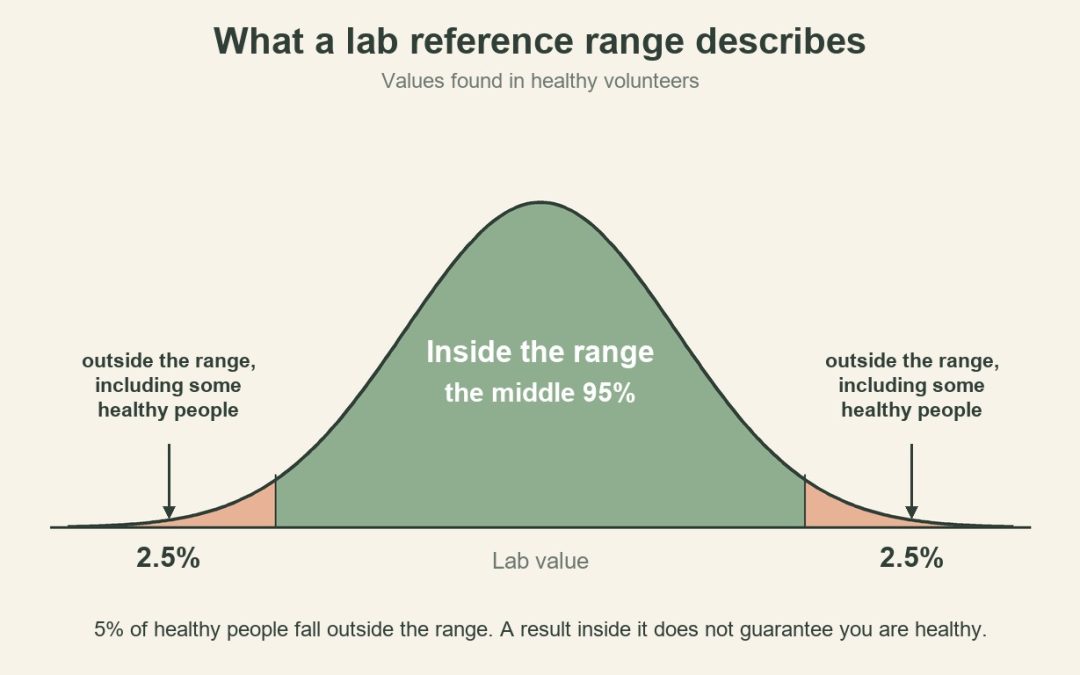
Normal blood work means your results fall inside a lab reference range, not that nothing is wrong. Fatigue can come from sleep problems, thyroid or iron issues, mood, medications, stress and more. Ask your doctor which of these were checked, then consider a root-cause look at your nervous system, blood sugar, gut and hormones.
By the time someone sits down with me holding a stack of normal results, she has usually already done the hard part: she noticed, she called, she sat through the blood draw, and she waited for the portal to update. Then the message arrived, every line inside its range, and the afternoon slump was still there.
If you are tired all the time but your blood work is normal, you are not making it up. The report was simply built to answer a narrower question than the one you are asking, and what I notice first is what was ordered.
Tired All the Time and Your Blood Work Is Normal: What the Range Really Means
A lab reference range is not a goalpost. It is a description of a crowd. According to Houston Methodist Laboratory Services, reference ranges are most often set by testing samples from healthy volunteers and keeping the values found for 95% of them, which means 5% of healthy people land outside the range. The same document puts the limit plainly: “Test results within the reference range do not guarantee you are healthy.”
None of this means your doctor ran the wrong tests. A first-pass workup is built to find the common, well-defined causes first, and a 2023 review in American Family Physician notes that testing without a specific reason may change treatment in only about 5% of patients. So the useful question is what the basics were built to find, and what they were never designed to see.
First, Rule Out the Medical Causes With Your Doctor
Fatigue has well-documented medical causes, and they deserve a real answer from the clinician who knows your history.
Cleveland Clinic physician guidance from 2026 names sleep disorders, anemia, thyroid problems, and depression or anxiety among the common causes, along with certain medications, including some allergy antihistamines. Questions to ask your doctor:
- Sleep. Ask about both quantity and quality, and about signs of sleep apnea such as loud snoring, pauses in breathing or waking up gasping, which the National Heart, Lung, and Blood Institute lists among its symptoms.
- Anemia and iron. Ask whether a complete blood count was run. A 2021 German primary care review also lists ferritin for premenopausal women whose basic workup comes back normal.
- Thyroid. Ask whether TSH, the thyroid-stimulating hormone, was checked.
- Mood. Ask about screening for depression and anxiety. The AAFP review advises clinicians to use validated questionnaires for sleep, mood and substance use.
- Medications. Ask whether anything you take is known to cause tiredness. Please do not change or stop a medication on your own; bring the question to the prescriber.
- Blood sugar. Ask whether glucose was checked, and whether it was a fasting sample.
- Vitamin D and other nutrient levels. Mayo Clinic lists low vitamin D among the conditions linked to fatigue.
- Pregnancy. Mayo also lists it, so ask about it if it is a possibility.
For a busy household in Brentwood or Franklin, a long workday followed by the kitchen table can leave sleep as the first thing to pay. If you wake in the night, why you wake up at 3 a.m. walks through that pattern.
The German review (Maisel et al., Deutsches Arzteblatt International, 2021) named depression (18.5%), sleep disorders and excessive psychosocial stress among the most common causes of persistent fatigue, and called previously undiagnosed cancer a rare cause, at 0.6% of cases.
What Normal Blood Work Can Miss: Five Places Root-Cause Care Looks
A basic panel works like one gauge on a car dashboard. The fuel gauge is accurate, and it still cannot tell you about tire pressure, engine temperature, or the light that came on an hour ago. Root-cause care reads more of the dashboard and never replaces the gauge your doctor already read.

None of the five lenses below is a diagnosis. Each is information that may help shape a supportive plan, alongside your doctor’s care.
1. Your nervous system’s state. An INSiGHT nervous system scan is designed to look at how your nervous system recovers from stress through heart rate variability (HRV), among other measures. A blood draw does not measure that.
2. Your blood sugar pattern across the day. A fasting glucose is one number at one hour of one morning. How you feel two or three hours after meals, and whether your mid-afternoon slump follows the same lunch every time, is a different question about blood sugar and the insulin response behind it.
3. Your daily cortisol rhythm. Cortisol, the stress hormone, follows a daily cycle with a profound increase after waking, as Fries and colleagues described in the International Journal of Psychophysiology in 2009. A single blood draw captures one moment of that cycle. We use the DUTCH Complete to look at cortisol and hormone metabolites across a day.
4. Your gut and your food reactions. A stool panel can add information about the gut microbiota. An international expert panel (Porcari et al., Lancet Gastroenterology & Hepatology, 2025) says evidence for the clinical usefulness of microbiome testing is scarce, so we weigh a result as one clue and not a verdict.
A food sensitivity panel is likewise not an allergy test. It measures IgG, and the Canadian Society of Allergy and Clinical Immunology describes food IgG as a marker of exposure and tolerance and discourages using it to identify or predict food reactions. We use it only to shortlist foods for an elimination-and-reintroduction trial, never on its own, and a negative result never rules out a true allergy.
5. Your toxin and environmental load. A Total Tox Burden panel looks at markers of environmental toxin exposure, and we use it for education about your exposures, never to diagnose a condition.
You may have searched for “adrenal fatigue” on the way here. A systematic review of 58 studies in BMC Endocrine Disorders (Cadegiani and Kater, 2016) concluded that “adrenal fatigue is still a myth,” and the Endocrine Society states: “No scientific proof exists to support adrenal fatigue as a true medical condition.” What is real is the stress-response loop called the hypothalamic-pituitary-adrenal (HPA) axis and the daily cortisol rhythm above, which is why we look at patterns instead of labels.
For a wider read on the pieces that can pull energy down, see more on root causes of fatigue and hormone imbalance.
Where The Healing Place in Franklin Starts: Scan the Nervous System, Then Look at the Cells
At The Healing Place in Franklin we start with the nervous system and then move to the cells. At our office at 1261 Columbia Ave, the first step is the INSiGHT scan, designed to look at stress recovery through HRV, muscle tension along your spine, and how evenly your body regulates itself by temperature. Then comes the cellular side: a metabolic questionnaire about your gut, liver, blood sugar and thyroid, and a 3-day nutrition diary. Labs enter only when a result will change the plan.
We bring both halves together in your Neurocellular Score, your scans plus everything you tell us, shown as “one number, 0 to 100, for the whole you.” It is a snapshot and not a diagnosis.
Where a lab does make sense, this is which question each test answers and, just as important, what it cannot tell you. The full menu lives on our functional testing menu.
| Test | The question it helps with | What it cannot tell you |
|---|---|---|
| Comprehensive Metabolic Panel | Your basic chemistry, including glucose and, in our custom version, thyroid markers | Why you are tired; it is a starting snapshot, not a cause |
| DUTCH Complete | Your cortisol pattern across a day, and how your hormones are being broken down | A diagnosis; it shows a pattern we use to shape a supportive plan |
| Gut Zoomer | Your stool microbiome and its markers | A diagnosis; expert consensus says evidence for microbiome testing in clinical decisions is still scarce |
| Food Sensitivity | Which foods your immune system has been exposed to, as a starting point for a food-and-symptom log and an elimination trial | Whether a food is causing your symptoms, or whether you have a food allergy, which is an allergist’s question |
| Total Tox Burden | What your environmental toxin markers show about exposure | That toxins are causing your symptoms |
Your plan is read alongside Dr. Anthony Putrus, DC, and the care team I trained, and you can read more about my background on our team page.
Your Next 14 Days: What to Track and What to Bring to Your Appointment
For two weeks, jot a few lines a day at the same times and bring the pages with you. Patterns show up on paper that memory smooths over in the exam room, and a mid-afternoon slump is easier to read when you can see it follows the same lunch, or the same afternoon in Cool Springs.
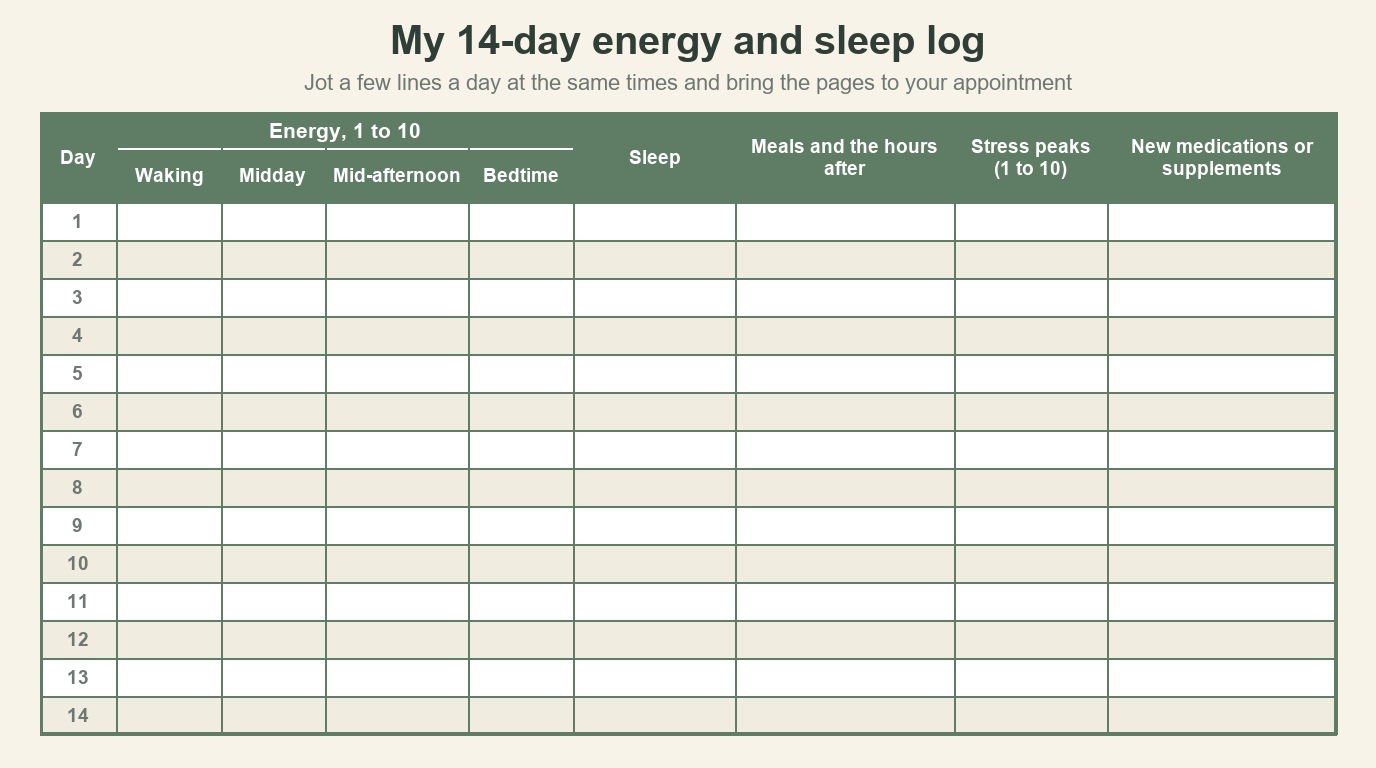
| What to note | How | What it helps your clinician see |
|---|---|---|
| Energy | Rate it 1 to 10 at waking, midday, mid-afternoon and bedtime | When the dips happen and whether they repeat |
| Sleep | Bedtime, wake time, night waking, how rested you feel | Sleep quantity and quality, plus snoring or gasping if a partner mentions it |
| Meals and the hours after | What you ate, and how you feel 2 to 3 hours later | Whether energy follows your eating pattern |
| Stress peaks | Mark hard moments from 1 to 10 | Links between stress load and energy |
| New medications or supplements | Name and start date | Timing links to raise with your prescriber |
When to See a Doctor Sooner
The sources below sort warning signs into three tiers, and I have kept each sign in the tier its source uses.
Emergency: call 911 or go to the emergency room if you have fatigue along with any of these (Mayo Clinic; Cleveland Clinic):
- Chest, arm or upper-back pain, or shortness of breath.
- A fast, slow, pounding or irregular heartbeat, or a feeling that you might pass out.
- Severe stomach, pelvic or back pain.
- Unusual bleeding, including bleeding from the rectum or vomiting blood.
- Severe headache or vision problems, especially after a head injury.
- Nausea, vomiting or abdominal pain, or new muscle weakness.
- Thoughts of harming yourself or others. Call or text 988, the Suicide & Crisis Lifeline described by the National Institute of Mental Health, or call 911.
Contact your provider right away if you have (MedlinePlus):
- Confusion or dizziness.
- Blurred vision.
- Little or no urine output.
- Recent swelling and weight gain.
Book an appointment if you have (MedlinePlus; Cleveland Clinic; Mayo Clinic; National Heart, Lung, and Blood Institute):
- Unexplained fatigue, especially with a fever, unintentional weight loss or regular sweats.
- Fatigue that comes on suddenly, has no clear reason, lasts longer than a few days, or keeps you from work or daily life, or fatigue at age 65 or older.
- Loud snoring, pauses in breathing or waking up gasping. Ask for a sleep evaluation.
- Low mood or hopelessness.
- Fatigue that two or more weeks of rest, stress reduction and good food have not helped.
Frequently Asked Questions
Why am I always tired?
Fatigue is a symptom and not a disease, so the answer is rarely one thing. Cleveland Clinic physicians point to sleep disorders, anemia, thyroid problems, and depression or anxiety, and some allergy antihistamines can add to it. Start with your doctor’s list, then keep the 14-day log to narrow down patterns.
Why am I tired all the time?
Tiredness that lasts for weeks is worth a visit, even when the first labs look fine. MedlinePlus advises contacting your provider if you have felt tired for weeks, and Mayo Clinic suggests an appointment when two or more weeks of rest, stress reduction and good food have not helped. Bring your log to that visit.
What could be causing me to feel exhausted by life?
Depression, anxiety, sleep problems, medications and long stretches of stress are common drivers your doctor can screen for. If the exhaustion comes with thoughts of harming yourself, call or text 988 or call 911 now. With low mood or hopelessness, book a visit with your doctor.
What blood tests check for fatigue, and what should I get checked if mine are normal?
A German primary care review lists fasting blood sugar, a complete blood count, ESR or CRP, liver enzymes and TSH as a basic workup, with ferritin added for premenopausal women whose first results are normal. The AAFP says the workup should follow your history and exam. If it all looks normal, review the checklist above, then consider a root-cause look.
Is normal the same as optimal?
No. Houston Methodist Laboratory Services explains that reference ranges are usually built from the values found in 95% of healthy volunteers, so 5% of healthy people fall outside them. It also says results within the range do not guarantee you are healthy. Normal describes a crowd, so bring your symptoms and your log to your doctor.
What can cause fatigue that routine blood tests miss?
Sleep disorders such as sleep apnea, depression or anxiety, some medications and stress are common causes of fatigue that are screened through your history and questionnaires, not a basic blood panel. Cleveland Clinic names all four, and the AAFP advises validated screening tools for sleep and mood plus a medication review. Ask your doctor which were covered.
Can a blood test diagnose chronic fatigue syndrome?
No single blood test does. The CDC describes ME/CFS as identified by a pattern of required symptoms, and says the physiological changes found so far are not sensitive or specific enough for diagnosis. For the condition itself, see our chronic fatigue page.
Getting Started With Root-Cause Care in Franklin
A clean report did not make your exhaustion any less real, and you have spent real energy proving it to yourself and to everyone around you. That is why we start by listening at 1261 Columbia Avenue in Franklin. Our team reads your whole story, your sleep, your meals, your stress, your cycle, and the results you already hold, then tells you plainly what we see and what we are still working out.
Under my direction, our functional medicine team would be honored to sit down with you, begin with your nervous system, and build a plan around what we find together. Start with a consultation, and learn more about our functional medicine in Franklin, TN. Call (615) 455-5350 or book your first visit and bring your stack of normal results with you.
