
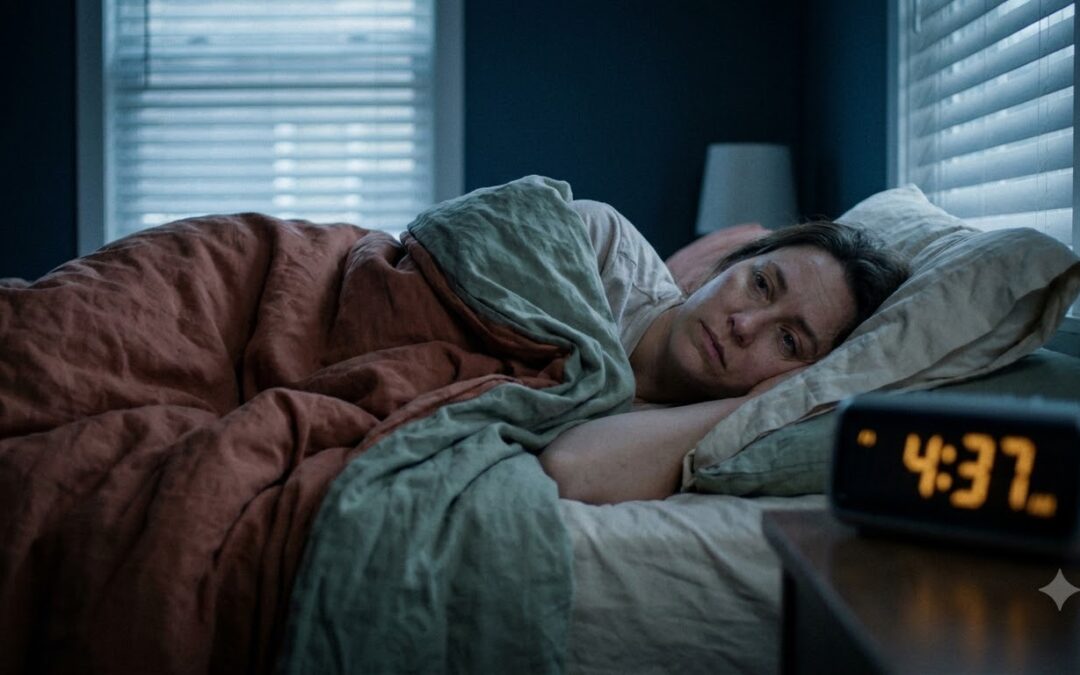
It’s 3:07 Again
It’s 3:07 again. You are staring at the ceiling, heart beating just a little too fast for a person lying still in a dark, quiet house. The day’s to-do list has already started running on a loop in your head, even though the day hasn’t started yet. Somewhere outside your window, Franklin is still asleep, and you are the only one awake in it.
Why do I wake up at 3am, night after night, when nothing about my life looks like an emergency? That is the question most women ask me before they ask anything else. There is rarely a dramatic reason.
You didn’t do anything wrong, and your body isn’t broken. It is sending you a signal, and it is worth learning to read it instead of just enduring it.
Some nights you drift back off by 3:30. Other nights the clock creeps toward 5:00, and the alarm still goes off at 6:00, and you start the day already behind on rest you never got. If this has become a pattern rather than an occasional bad night, three hormones are usually part of the story: cortisol, melatonin, and progesterone.
Why the Second Half of the Night Is Different

Sleep is not one flat state from 10 p.m. to 6 a.m. The first few hours are usually the deepest, the kind of sleep that is hardest to wake someone out of. As the night goes on, sleep naturally grows lighter and more fragmented, which is simply how a normal night is built, not a sign that anything is wrong with you.
Think of a house settling for the night. Early on, everything has gone quiet: the furnace has cycled down, the dishwasher has finished, the whole structure has settled into stillness. By 3 or 4 a.m., small sounds start again, a floorboard, the furnace kicking back on, a car outside, and in a lighter stage of sleep, those small sounds are more likely to reach you.
That lighter second half of the night is exactly when a hormone shift can tip you from lightly asleep to wide awake. Research on cortisol’s daily rhythm has found that higher cortisol levels before sleep predict a shorter total sleep time and a harder time staying asleep through the night (Liu, 2024). What your stress hormone was doing earlier in the evening can shape whether 3 a.m. finds you asleep or staring at the ceiling.
What Hormone Wakes You Up at 3 a.m.? Three of Them, Actually
What hormone wakes you up at 3 a.m.? Honestly, it is rarely just one. Three separate hormone patterns are converging in your body at that exact hour, and each one is doing something you can actually feel.
Cortisol, the hormone your adrenal glands release in a rhythm across the day, hits its lowest point around midnight and then starts climbing again around 2 to 3 a.m., well before your alarm ever goes off (Chan & Debono, 2010). That early rise is supposed to be gradual, easing you toward morning. When your nervous system is stuck in survival mode, that same rise can arrive sharper and earlier, and a sharper cortisol rise reads to your brain as urgency, not a gentle wake-up call. We walk through what drives that pattern in more depth on our page about high cortisol and the HPA axis.
Melatonin is moving in the opposite direction. It peaks in the middle of the night, with studies in older adults putting that peak often right around 3 a.m., then it tapers off as morning approaches (Godfrey et al., 2022). Anything that blunts that peak, too much light in the evening, too little daylight during the day, or simply getting older, can mean less melatonin is on board to keep you asleep through that cortisol rise (Kozaki et al., 2015).
Then there is progesterone, and its calming byproduct allopregnanolone, which works on the same brain receptors as anti-anxiety medications to help you stay asleep (Haufe & Leeners, 2023). For a mom in Cool Springs juggling a full calendar and a body moving through perimenopause, declining progesterone often means losing that calming effect right when cortisol is starting its early climb. That is a genuinely rough combination, not a coincidence.
The Other Usual Suspects
A few other everyday factors deserve a mention here. Blood sugar really does run somewhat lower overnight, even in people with no blood sugar disorder at all (Liang, 2022). Separately, research on daytime glucose drops shows the body responds by releasing the same stress hormones involved in waking, cortisol and adrenaline among them (Verhulst et al., 2022).
That specific chain, a blood sugar dip triggering a 3 a.m. wake-up, hasn’t actually been studied during sleep at all, in anyone, so we hold it as a plausible idea rather than a settled explanation for your night. If you notice waking with shakiness, sweating, or a racing heart, mention that combination to your physician.
Alcohol is a more familiar culprit for a lot of women. It can help you fall asleep faster, but research on the second half of the night tells a different story: alcohol disrupts REM sleep specifically, delaying it and shortening it as your body finishes metabolizing what you drank (Gardiner et al., 2025). That disruption tends to land in exactly the window we are talking about.
A too-warm bedroom, caffeine lingering longer than you’d expect, a full bladder, and a phone screen at midnight all play smaller, more familiar roles too. None of them are dramatic on their own. All of them are worth a look before assuming the cause is something bigger.
When 3 a.m. Is a Red Flag
Most 3 a.m. waking is hormonal and rhythm-related, the kind we have been describing. But there are three patterns that deserve a physician’s attention rather than a hormone panel, and naming them plainly is part of taking care of you well.
Snoring, gasping, or choking sounds during sleep, a partner who has noticed pauses in your breathing, or daytime sleepiness that no amount of coffee touches can point to obstructive sleep apnea, a condition where your airway becomes blocked repeatedly during the night, pulling you out of deep sleep each time (NHLBI). It is diagnosed with a sleep study, not a hormone test, and if any of that sounds familiar, please talk to your provider about it directly.
Waking at the same early hour most nights, especially alongside low mood, a loss of interest in things you used to enjoy, or a flat, heavy feeling during the day, is a pattern researchers connect closely to depression (Nutt et al., 2008). That connection is worth taking seriously and worth screening for, not something to quietly push through.
Thyroid function is a third one to rule out. If early waking is showing up alongside other changes, your weight, your energy, your temperature regulation, ask your physician to check your thyroid as part of your workup. These three are exactly why your care team matters: a full picture, not a single hormone panel, is what actually protects you here.
What a Nervous System in Survival Mode Does at Night
Everything so far has been about specific hormones. There is also a broader pattern underneath most of them: a nervous system that has not learned how to downshift at the end of the day.
Think of your nervous system like a smoke alarm. A well-calibrated one goes off for real smoke.
An overly sensitive one goes off at the smell of toast, at steam from the shower, at nothing dangerous at all, it just can’t tell the difference anymore. A nervous system stuck in survival mode works the same way: it keeps signaling alarm at 3 a.m. even though nothing is actually wrong.
Many of the women who come to us describe days so full and so relentless that their nervous systems never quite get the memo that the day is over. They lie down, and their bodies are still running the day that just ended, still bracing for the next thing on the list.
Naming this pattern is one reason our functional medicine work and Dr. Anthony’s nervous-system work aren’t run as separate tracks here. They’re two windows onto the same problem, and reading only one of them tends to miss half the story.
Dr. Anthony Putrus, DC brings the nervous-system window through INSIGHT scanning, which tracks heart rate variability, essentially a number for how well your body downshifts into rest instead of staying braced for the next thing. It won’t replace a conversation about cortisol or melatonin. But it can show us something a hormone panel alone cannot: whether it’s your nervous system, and not only your hormones, that’s still running at high alert when the lights go off.
How We Look at This in Franklin
If waking at 3 a.m. has become a pattern rather than an occasional rough night, the next useful step is usually understanding your own pattern, not guessing at someone else’s.
A single 9 a.m. blood draw shows one point on a curve that moves all day and all night. That single point might sit inside a normal range and still miss what’s optimal for you.
This is where a DUTCH Complete test can help. It maps your cortisol pattern across a full day rather than one moment, and it also measures a melatonin metabolite that reflects how much melatonin your body put out overnight.
What it does not do is diagnose insomnia, sleep apnea, or any sleep disorder on its own. A low melatonin reading can track with some objective measures of how well you slept, at least in the older men that research followed, but it cannot tell us how rested you felt or whether your breathing was interrupted overnight (Saksvik-Lehouillier et al., 2015). Labs are one piece of that picture, and your actual symptoms and history are what turn a number into something worth acting on.
We work through this with women here in Franklin, and with families driving in from Thompsons Station and across Williamson County who have already spent real time chasing an explanation. If your DUTCH results and your INSIGHT findings tell two parts of the same story, a hormone piece and a nervous system piece, that combination usually gives us a far clearer place to start than either one alone. You can read more about Dr. Amy’s approach to functional medicine on her provider bio, and more about what a DUTCH test does and does not show on our dedicated page.
What You Can Try Tonight

A few small changes are worth trying regardless of which hormone is driving your particular night. Dim the lights for the last hour or two before bed, since evening light exposure is part of what blunts your natural melatonin rise (Kozaki et al., 2015).
Turn the clock away from you, or cover it, so a 3 a.m. glance does not turn into twenty minutes of doing math about how little sleep is left. If you have an evening drink, give yourself more runway before bed than you think you need, since that second half of the night is where alcohol does its damage.
If you wake and cannot fall back asleep within about twenty minutes, get up. Sit somewhere dim and quiet rather than lying there getting frustrated, and go back to bed once you feel sleepy again. This habit is part of a structured approach called cognitive behavioral therapy for insomnia, or CBT-I, which sleep medicine’s own clinical guidelines recognize as the strongest first-line option for chronic insomnia, ahead of medication (Edinger et al., 2021).
None of this replaces understanding your own pattern. No guesswork, no one-size-fits-all: these are a starting point while you figure out whether cortisol, melatonin, progesterone, or your nervous system is the root cause carrying the most weight for you specifically.
Frequently Asked Questions
A few questions come up again and again in these conversations. Some are about the cortisol and sleep connection specifically; others are simply about why someone keeps waking up at 3am every night, or whether their sleep hormones are the real problem underneath it all.
How can I break the cycle of waking up at 3 a.m.?
Start with what’s within your control: dim light in the evening, a consistent bedtime, and an honest look at whether alcohol or a warm bedroom is part of your specific pattern. If the pattern has lasted for months despite those changes, testing your actual cortisol, melatonin, and nervous system patterns replaces guessing with a real map.
How do I stop cortisol spikes at 3 a.m.?
You don’t actually want to fully stop this rise. A pre-dawn cortisol increase is a normal, necessary part of waking up. The goal is a rise that arrives gently and on schedule rather than sharply and early, which usually comes down to supporting your nervous system and your overall rhythm rather than suppressing a hormone that is doing its job.
Is waking up at 3 a.m. a sign of high cortisol?
It can be one piece of the picture, but it is rarely the whole explanation. Melatonin’s overnight decline and progesterone’s calming effect both play a role too, which is why we look at the full overnight pattern rather than assuming cortisol alone.
Does perimenopause cause 3 a.m. waking?
Perimenopause can absolutely be part of it. As progesterone declines during this transition, its naturally calming effect on your nervous system fades too, right around the same years cortisol patterns often shift from years of accumulated stress. Our perimenopause page walks through this stage in more depth.
What is the myth about waking up at 3 a.m.?
You may have come across the idea that waking at exactly 3 a.m. carries a spiritual or symbolic meaning. That isn’t what this page is about. The real, physiological story is that this hour sits at a genuinely meaningful crossing point for cortisol, melatonin, and progesterone, the three hormones we’ve walked through above.
Sleeping Through the Night Again in Franklin
A better mattress, less coffee, a new pillow. Plenty of the women we sit down with worked through that same list first, driving in from Nolensville, from Thompsons Station, and from all over Middle Tennessee, before ever picking up the phone about a 3 a.m. waking that would not shift.
Dr. Amy and the functional medicine team she trained will take the whole pattern seriously, not just the hour on the clock. You deserve a real look at what is driving it instead of another guess. Come sit down with us at our Franklin office on Columbia Avenue, and book a consultation.
This page is for educational purposes only and is not a substitute for professional medical advice, diagnosis, or treatment. Always consult your physician or a qualified health provider about your health and before beginning any new care.
